
Tohlezkus inexpectus
Vit, 1995
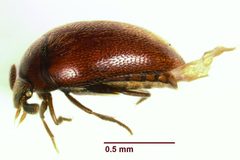
Tohlezkus inexpectus is a small in the Eucinetidae, first described from the Czech Republic in 1995. It has since been documented across central Europe and the eastern United States, making it a transatlantic species with a disjunct distribution. The species is typically collected in forested using passive trapping methods.
Pronunciation
How to pronounce Tohlezkus inexpectus: //toʊˈhlezkʊs ɪnɪkˈspɛktəs//
These audio files are automatically generated. While they are not always 100% accurate, they are a good starting point.
Identification
As a member of Eucinetidae, Tohlezkus inexpectus can be recognized by the -diagnostic plate-like expansions on the hind . The Tohlezkus is distinguished from other eucinetid genera by specific antennal and pronotal characters described in the original description (Vit 1995). Specific identification requires examination of male genitalia and other fine morphological details.
Images
Habitat
Forested , particularly moist woodland environments with decaying organic matter. Specimens have been collected using intercept traps and pitfall traps, indicating ground-dwelling or low-vegetation activity.
Distribution
Native to Europe: Czech Republic (type locality), Austria, Germany, Hungary, Italy, Poland, Slovakia, and Slovenia. Introduced or native to North America: eastern United States including New York, Pennsylvania, Virginia, West Virginia, and Ohio.
Behavior
Collected using intercept traps and pitfall traps, suggesting activity near the ground surface or in low vegetation. The specific of or larvae remain undocumented.
Similar Taxa
- Other Eucinetidae generaShare the diagnostic plate-like hind ; require examination of antennal structure and pronotal shape for separation from Tohlezkus
- Eucinetus spp.The most commonly encountered eucinetid ; Tohlezkus differs in antennal club structure and body proportions
More Details
Collection methods
All documented specimens have been collected using intercept traps or pitfall traps, suggesting the is not readily captured by hand or standard beating techniques.
Transatlantic distribution
The ' presence in both Europe and eastern North America may represent human-mediated introduction, though this has not been formally assessed. The disjunct pattern is unusual for a -capable with apparent forest specialization.