
Eucinetidae
Lacordaire, 1857
Plate-thigh Beetles
Genus Guides
4- Eucinetus(plate-thigh beetles)
- Euscaphurus(plate-thigh beetles)
- Nycteus
- Tohlezkus
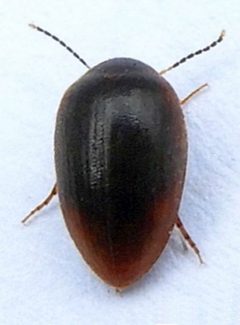
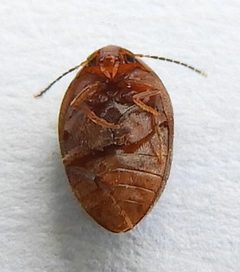
is a small of beetles comprising approximately 37-50 across 9-11 worldwide. Members are distinguished by enlarged coxal plates that cover much of the first ventrite of the , giving rise to their "plate-thigh beetles." The family exhibits remarkable evolutionary stasis, with the extant genus Eucinetus documented from mid-Cretaceous amber approximately 100 million years ago, indicating persistence of subcortical lineages through stable cryptic microhabitats over vast geological timescales.
Pronunciation
How to pronounce Eucinetidae: //juːˈsɪnɪtiːdiː//
These audio files are automatically generated. While they are not always 100% accurate, they are a good starting point.
Identification
The combination of small size (under 4 mm), elliptical body shape, deflexed , and especially the enlarged hind coxal plates covering the first ventrite distinguishes from other small . Around half of the possess strongly modified mouthparts, particularly an enlarged , adapted for suctorial feeding. -level identification requires examination of antennomere structure, leg spination, and spur .
Images
Appearance
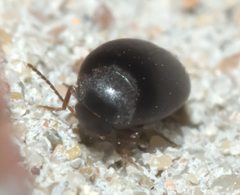
are small, elliptical beetles measuring 0.8–4.0 mm in length. Coloration is typically black or brown. The is small and deflexed (bent underneath the pronotum). The most distinctive feature is the greatly enlarged coxal plates of the hind legs, which extend posteriorly to cover much of the first abdominal ventrite. Antennal and leg varies among and serves as diagnostic characters for identification.
Habitat
and larvae inhabit detritus and fungus-covered tree bark. The exhibits a subcortical lifestyle, occupying stable cryptic microhabitats beneath bark surfaces. These microhabitats have remained sufficiently unchanged to permit lineage persistence from the Cretaceous to present.
Distribution
Worldwide distribution. Documented from: Europe (Denmark, Norway, Sweden), Asia (Korea, Japan, Myanmar, China), and North America (USA: Illinois, Iowa, Nebraska, Missouri). Fossil records from Early Cretaceous (Hauterivian) of China and mid-Cretaceous (Albian-Cenomanian) Burmese amber of Myanmar.
Diet
Both and larvae feed on fungi. Around half of the possess suctorial mouthpart modifications, particularly of the , suggesting specialized fungal feeding.
Behavior
Occupies stable cryptic microhabitats beneath bark, a lifestyle that has persisted with minimal morphological change since at least the mid-Cretaceous. The Eucinetus represents a documented case of long-term evolutionary stasis spanning approximately 100 million years.
Ecological Role
Fungivores in subcortical ; contribute to decomposition of fungal material in dead wood and bark .
Similar Taxa
- ClambidaeAlso small beetles in superfamily Clamboidea, but lack the enlarged coxal plates characteristic of ; Clambidae have more exposed abdominal ventrites
- ScirtidaeRelated in Scirtoidea, but generally larger with different body proportions and without the distinctive plate-like hind
More Details
Evolutionary significance
Eucinetus is a key example of morphological stasis, with extant nearly identical to mid-Cretaceous fossils from 99 million year old amber. This demonstrates that stable microhabitats can buffer lineages against morphological change over vast geological timescales.
Mouthpart diversity
The shows bimodal mouthpart evolution: approximately half the retain generalized mouthparts, while half have evolved strongly modified suctorial mouthparts with enlarged , suggesting adaptive radiation into different fungal feeding strategies.
Sources and further reading
- BugGuide
- Wikipedia
- GBIF taxonomy match
- iNaturalist taxon
- NCBI Taxonomy
- Catalogue of Life
- Little known Eucinetidae (Coleoptera: Scirtoidea) in Korea
- New State Record for Tohlezkus inexpectus Vit, 1995 (Coleoptera: Eucinetidae) with a Summary of Distribution and Collection Data
- Three new species of the extant genus Eucinetus from mid-Cretaceous amber of northern Myanmar (Coleoptera: Eucinetidae)