
Trox gemmulatus
Horn, 1874
Hide beetle
Trox gemmulatus is a hide beetle in the Trogidae, native to arid and semi-arid regions of western North America. These beetles specialize in consuming desiccated animal remains, including dried skin, fur, feathers, and connective tissue. are typically 8–11 mm in length and are known for their rough, debris-caked appearance and —feigning death when disturbed. The is most active during spring and is frequently associated with the final stages of vertebrate decomposition.
Pronunciation
How to pronounce Trox gemmulatus: /trɔks dʒɛm.jʊˈleɪ.təs/
These audio files are automatically generated. While they are not always 100% accurate, they are a good starting point.
Identification
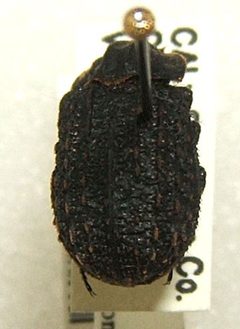
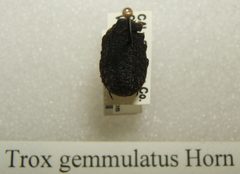
Trox gemmulatus can be distinguished from other Trogidae by its small size (8–11 mm) and the presence of distinct tuberculate or sculpturing on the , reflected in the epithet 'gemmulatus' (bearing small gems or ). The body is broadly oval and dorsoventrally flattened. When alive, specimens are typically encrusted with soil and debris, rendering coloration difficult to discern. The are (clubbed with plate-like segments), a characteristic. Separation from the similar Trox sonorae requires examination of male genitalia or detailed comparison of elytral sculpturing patterns.
Images
Habitat
Arid and semi-arid environments including desert scrub, grasslands, and open rangeland. Associated with vertebrate carcasses in advanced decomposition, particularly dried remains where skin, hair, or feathers persist. Also recorded from scat containing undigested fur.
Distribution
Western United States (Arizona, California, New Mexico, South Dakota) and northwestern Mexico (Baja California).
Seasonality
have been observed active in spring (March–April), with activity likely extending into early summer depending on local conditions.
Diet
Dried animal matter including desiccated skin, fur, feathers, hair, and connective tissue. and larvae feed on the same substrates.
Life Cycle
Complete (holometabolous). Larvae develop within or adjacent to dried carcass material, feeding on keratinaceous tissues. occurs in soil. Specific developmental rates and voltinism have not been documented for this .
Behavior
Exhibits pronounced (death-feigning) when disturbed, freezing in a rigid, contorted posture that can be maintained for several minutes. are often caked with debris, rendering them cryptic and difficult to detect. or activity patterns suspected but not confirmed.
Ecological Role
Decomposer specializing in the terminal stages of vertebrate decomposition, reducing dried keratinaceous remains to fragments. Facilitates nutrient cycling in arid where decomposition rates are slow. Serves as prey for .
Human Relevance
Has potential application in for estimating minimum postmortem interval in cases involving mummified remains. No known economic importance; occasionally encountered by wildlife biologists and forensic investigators.
Similar Taxa
- Trox sonoraeOverlapping distribution and ; distinguished by male genitalia and subtle differences in elytral sculpturing
- Trox scaberLarger size and more widespread distribution; T. gemmulatus is smaller with more pronounced granulation
- Dermestes spp.Also found on dried remains; distinguished by more elongate body form, shorter , and different elytral texture