
Trox capillaris
Say, 1824
Hide beetle
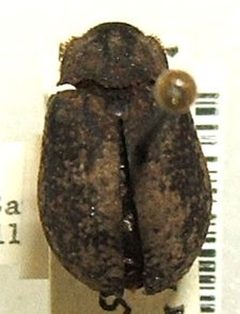
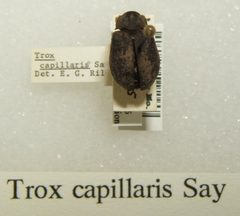
Trox capillaris is a of hide beetle in the Trogidae, first described by Thomas Say in 1824. As a member of this family, it is associated with the late stages of vertebrate decomposition, feeding on dried skin, hair, feathers, and connective tissue. The species occurs in the Nearctic region, primarily in the central and eastern United States and southern Canada.
Pronunciation
How to pronounce Trox capillaris: /trɑks kæpɪˈlɛərɪs/
These audio files are automatically generated. While they are not always 100% accurate, they are a good starting point.
Images
Habitat
Associated with decomposing vertebrate remains, particularly in the advanced stages of decay when dried skin, hair, and connective tissue remain. Has been observed on coyote scat containing fur from prey animals.
Distribution
Nearctic region: United States (Illinois, Indiana, Iowa, Kansas, Maryland, Nebraska, New Mexico, South Carolina, Texas, Wisconsin, Vermont) and Canada (Ontario).
Diet
Dried animal matter including skin, hair, feathers, fur, and connective tissue from decomposing vertebrate carcasses.
Behavior
characteristically become motionless and rigid when disturbed, a described as 'playing dead' or voluntary coma. They are typically covered in debris, making them difficult to detect.
Ecological Role
Decomposer; contributes to the breakdown of keratinous and collagenous materials in late-stage carcass decomposition.
Human Relevance
May be encountered by forensic entomologists at crime scenes involving decomposed remains. Generally harmless to humans and not considered a pest of stored products or living animals.
Similar Taxa
- Trox sonoraeSimilar size range (8-11 mm) and preference for dried carrion; distinguished by geographic range and subtle morphological differences in pronotal and elytral .
- Dermestes speciesAlso found on carrion and bones in later decomposition stages, but belong to Dermestidae with different body form (more elongate, with clubbed ) and .
More Details
Family characteristics
Trogidae are closely allied to Scarabaeidae (scarab beetles) and share some morphological features, but are distinguished by their rough, often debris-covered and specialized feeding habits on dried animal matter.