
Onitis alexis
Klug, 1835
Bronze Dung Beetle
Onitis alexis, commonly known as the bronze dung beetle, is a dung beetle in the Scarabaeidae. Native to Africa and parts of the Mediterranean region, it has been introduced to Australia where it has become established in warmer northern regions. The species has been studied for its and survival strategies in marginal environments at the southern edge of its Australian range. It belongs to a of dung beetles that play important roles in nutrient cycling through burial activities.
Pronunciation
How to pronounce Onitis alexis: /ɔˈnɪ.tɪs əˈlɛk.sɪs/
These audio files are automatically generated. While they are not always 100% accurate, they are a good starting point.
Identification
The bronze coloration provides a field clue to identification, though this should be confirmed with reference specimens. In Australia, it can be distinguished from native dung beetles and other introduced by its specific and distribution patterns. The species is part of the Onitini tribe, which can be separated from other dung beetle tribes by morphological features of the legs and . Accurate identification to species level requires examination of genitalia and other detailed morphological characters.
Images
Appearance
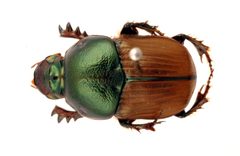
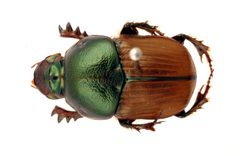
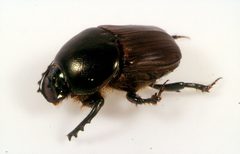
have a bronze-colored , consistent with the . As a member of the Onitis, the exhibits the typical robust, rounded body form characteristic of many dung beetles. in horn development is common in the genus, though specific details for this species are not documented in available sources.
Habitat
In its native range, found in savanna and grassland . In Australia, occupies pastoral and agricultural landscapes where cattle is available. At the southern limit of its Australian distribution in the Araluen Valley, survives in a marginal environment with cold winters and variable summer conditions. Requires access to dung resources for and larval development.
Distribution
Native to Africa (including South Africa, Botswana, Cameroon, Eritrea), Syria, Spain, Tunisia, and Greece. Introduced to Australia, where established in warmer regions of northern Australia with a south-eastern limit near Moruya, New South Wales. Also reported from Oceania.
Seasonality
In the Araluen Valley, newly emerged are present in from late spring through summer and autumn. -laying commences 1-2 weeks after and continues through summer and autumn. Adults have been observed to survive winters in some years. Development timing varies with temperature and moisture conditions.
Diet
Feeds on , primarily from large herbivores. Larvae develop within dung pads or in soil beneath them.
Life Cycle
Complete with , larval, pupal, and stages. Eggs laid in December-January produce adults in late summer and autumn; eggs laid February-April produce adults the following spring and summer. Larvae enter a cold-induced that facilitates winter survival. High larval mortality occurs in cold, wet conditions. Development is delayed in warm, dry conditions.
Behavior
are active in from late spring through autumn. Females resorb ovarian follicles in response to increasing age and rainfall. The buries dung for food and , though specific tunneling are not documented in available sources.
Ecological Role
Functions as a decomposer, contributing to nutrient cycling and soil aeration through dung burial activities. As an introduced in Australia, it was likely introduced for biocontrol of dung accumulation in pastoral systems.
Human Relevance
Introduced to Australia as part of dung beetle importation programs aimed at managing cattle accumulation and improving pasture productivity. The has established successfully in warmer regions and contributes to dung removal in agricultural landscapes.
Similar Taxa
- Other Onitis speciesShare similar body form and bronze or metallic coloration; require examination of genitalia and detailed morphological characters for definitive separation
- Other introduced dung beetles in AustraliaOverlap in use and burial ; phenological patterns and distribution limits help distinguish O. alexis in the field
More Details
Subspecies
Two recognized: Onitis alexis alexis and Onitis alexis septentrionalis Balthasar, 1942
Survival Limitations
Larval survival is limited by wet winter conditions; this appears to be the major factor restricting southern expansion of the in Australia
Sources and further reading
- BugGuide
- Wikipedia
- GBIF taxonomy match
- iNaturalist taxon
- NCBI Taxonomy
- Catalogue of Life
- Native Bees to Share Spotlight at Bohart Museum Open House | Bug Squad
- Spiders Are Awesome! | Bug Squad
- In Tick Management, Species Matters
- One-Shot Wednesday—Proctacanthus fulviventris ovipositing | Beetles In The Bush
- advances in pollinator research | Blog
- The phenology of Onitis alexis (Coleoptera: Scarabaeidae) in the Araluen Valley: Survival in a marginal environment