
Onitini
Laporte, 1840
Genus Guides
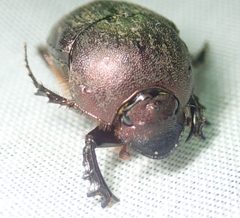
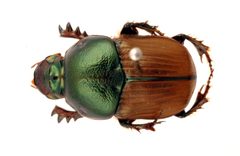
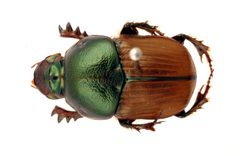
1Onitini is a tribe of dung beetles within Scarabaeidae, erected by Frederic William Hope. The tribe comprises approximately 18 including the type genus Onitis and the diverse genus Cheironitis. Members are primarily distributed across arid regions of the Palaearctic and Afrotropical regions, with some extending into the Oriental region. These beetles are associated with decomposition in dryland .
Pronunciation
How to pronounce Onitini: /ˌɔ.nɪˈtiː.ni/
These audio files are automatically generated. While they are not always 100% accurate, they are a good starting point.
Identification
Onitini can be distinguished from other Scarabaeinae tribes by a combination of morphological characters including the structure of the and genitalia, though specific diagnostic features vary by . Members of the genus Cheironitis within this tribe are recognized by their metallic luster and adaptations to arid environments. The tribe is considered part of the "old-world" dung beetle , with no native representatives in the Americas.
Images
Habitat
Arid and semi-arid regions including savannahs, steppes, and dry grasslands. Specific collection records include hill country at elevations around 900-910 m, historical sites with animal activity, and areas with seasonal dryness. Members are adapted to relatively dry conditions compared to many other dung beetle groups.
Distribution
Palaearctic region (including North Africa, Middle East, Central Asia, and Mediterranean Europe), Afrotropical region (sub-Saharan Africa), and eastward into parts of the Oriental region including China (Xinjiang). The tribe is absent from the Americas and Australia.
Seasonality
active during dry season conditions; specific collection records indicate activity in June and August.
Diet
; specifically observed feeding on horse dung and associated with mammalian dung in arid environments.
Behavior
Dry season active dung beetles. Some show specific associations; for example, Cheironitis aiweiae was found in association only with C. moeris, with no other Scarabaeinae species present, possibly due to particularly dry conditions during the collection period.
Ecological Role
Contributes to decomposition and nutrient cycling in arid . As Scarabaeinae dung beetles, members likely participate in dung burial and soil aeration, though specific ecosystem functions are less documented than for some other dung beetle tribes.
Human Relevance
Some occur near human settlements and historical sites where domestic animals provide resources. The tribe includes species discovered through citizen science efforts, including a new species described based on a middle school student's discovery in China.
Similar Taxa
- SisyphiniAnother tribe of rolling dung beetles in Scarabaeinae, but Sisyphini are distinguished by their rolling and different body proportions; Onitini are not known for rolling behavior.
- CopriniTribe of tunneling dung beetles with broader distribution including moist ; Onitini are more specialized to arid environments and have different genitalic structures.
More Details
Taxonomic history
The tribe was erected by Frederic William Hope and later formally described by Laporte in 1840. The type Onitis was established by Fabricius in 1798. The genus Cheironitis, a major component of the tribe, was established by van Lansberge in 1875 and now contains at least 24 .
Notable discoveries
Recent taxonomic work has expanded the known diversity of Onitini, including the description of Cheironitis aiweiae from Xinjiang, China by a middle school student in 2022, and the first record of C. moeris from China. These discoveries highlight the ongoing documentation of the tribe's distribution in Central Asia.
Sources and further reading
- BugGuide
- Wikipedia
- iNaturalist taxon
- Catalogue of Life
- Zookeys | Blog - Part 2
- A new species of Cheironitis van Lansberge, 1875 (Coleoptera, Scarabaeidae, Onitini) and the first record of Cheironitis moeris (Pallas, 1787) from China.
- A new species of Cheironitis van Lansberge, 1875 from Jordan (Coleoptera, Scarabaeidae, Onitini).