
Canthon pilularius
(Linnaeus, 1758)
common tumblebug, Eastern Tumblebug
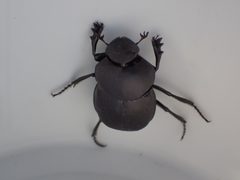
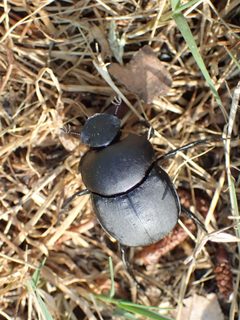
Canthon pilularius is a ball-rolling (telocoprid) dung beetle in the Scarabaeidae, commonly known as the common or Eastern Tumblebug. It is one of five North American in the pilularius species group. are known for their distinctive of forming balls and rolling them away from deposition sites for burial and larval development.
Pronunciation
How to pronounce Canthon pilularius: //ˈkænθɒn pɪljʊˈlɛəriəs//
These audio files are automatically generated. While they are not always 100% accurate, they are a good starting point.
Identification
Member of the pilularius group of Canthon; distinguished from by characters detailed in taxonomic keys (see Noriega & Vulinec 2020). Specific diagnostic features require examination of morphological characters not fully detailed in available sources.
Images
Distribution
Nearctic region: United States (widespread across eastern and central states including Alabama, Arkansas, Colorado, Connecticut, Florida, Georgia, Illinois, Indiana, Iowa, Kansas, Kentucky, Louisiana, Maryland, Massachusetts, Michigan, Minnesota, Mississippi, Missouri, Montana, Nebraska, New Hampshire, New Jersey, New Mexico, New York, North Carolina, Ohio, Oklahoma, Pennsylvania, Rhode Island, South Carolina, South Dakota, Tennessee, Texas, Vermont, Virginia, West Virginia, Wisconsin, Wyoming) and Canada (Alberta, Manitoba, Saskatchewan). Records also indicate presence in Oceania, though this may represent introduced or data artifacts.
Diet
; and larvae feed on fecal matter.
Life Cycle
Larvae develop within buried balls constructed by .
Behavior
Ball-rolling : form balls and roll them away from deposition sites to minimize competition with other dung beetles. Females bury balls and lay single inside; larvae complete development within the hollow sphere.
Ecological Role
Nutrient cycling through burial; contributes to soil aeration and nutrient redistribution.
Similar Taxa
- Canthon simplexSimilar ball-rolling and small size; C. simplex is smaller (7-8 mm) and has different distribution
- Canthon imitatorMember of same pilularius group; distinguished by morphological characters in taxonomic keys
- Canthon floridanusMember of same pilularius group; geographic separation aids identification
- Canthon vigilansMember of same pilularius group; requires examination of specific morphological characters for separation
- Canthon chalcitesMember of same pilularius group; distinguished by coloration and structural features
More Details
Taxonomic History
Original description as Scarabaeus pilularius by Linnaeus in 1758. Lectotype designated in taxonomic review by Noriega & Vulinec (2020). Member of the pilularius group, which comprises five North American in Canthon.
Behavioral Ecology
As a smaller dung beetle , likely employs 'sit and wait' perching strategy on vegetation to detect via chemoreception, rather than actively following animals. Perching height and may function as resource partitioning mechanism to reduce .
Sources and further reading
- BugGuide
- Wikipedia
- GBIF taxonomy match
- iNaturalist taxon
- Bug Eric: What's in Dat Scat?
- Where Dung Beetles Perch Says a Lot About Community Evolution
- Characterizing the Link Between Climate and Thermal Limits in Beetles
- You Can Thank Insects for Many Human Inventions
- You know what bugs me about dung beetles?… | Beetles In The Bush
- Uncategorized | Blog - Part 31
- Observations on the Ball‐Rolling Behavior of Canthon Pilularius (L.) (Coleoptera, Scarabaeidae)
- Taxonomic review of the pilularius species group of the New World dung beetle genus Canthon Hoffmannsegg, 1817 (Coleoptera: Scarabaeidae: Scarabaeinae: Deltochilini)