
Canthon
Hoffmannsegg, 1817
tumblebugs, dung rollers
Species Guides
10- Canthon blumei
- Canthon chalcites(Coppery Dung Beetle)
- Canthon cyanellus(Dung beetle)
- Canthon floridanus
- Canthon humectus
- Canthon imitator(tumblebug)
- Canthon indigaceus
- Canthon pilularius(common tumblebug)
- Canthon vigilans(vigilant dung beetle)
Canthon is a of ball-rolling dung beetles (telocoprids) commonly known as , distributed across the Nearctic and Neotropical regions. are known for their distinctive of forming balls and rolling them away from source material for feeding or nesting. The genus exhibits notable behavioral diversity, with some employing 'sit and wait' perching strategies to detect dung through chemoreception, while others actively follow animals. Several species show color that may be linked to thermal and elevational distribution.
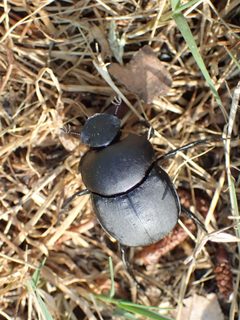
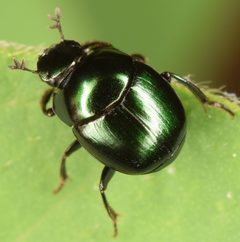
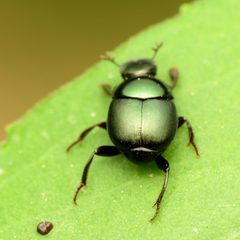
Pronunciation
How to pronounce Canthon: /ˈkænθɒn/
These audio files are automatically generated. While they are not always 100% accurate, they are a good starting point.
Images
Habitat
Found in diverse across the Nearctic and Neotropical regions, including temperate woodlands, grasslands, and tropical forests. Some occupy specific elevational zones; for example, Canthon rutilans cyanescens occurs below 1000m in rainforest habitats, while C. rutilans rutilans occurs above 1000m in grasslands, eucalyptus plantations, or forests.
Distribution
Nearctic and Neotropical regions, ranging from North America through Central America to South America. Specific distribution varies by ; the pilularius species group is restricted to North America, while other species extend into South America including Brazil, Argentina, and Uruguay.
Diet
; and larvae feed primarily on . Some may also be necrophagous, feeding on carrion.
Life Cycle
form spherical balls for resource storage and nesting. Females bury balls and lay inside; larvae develop within the ball, feeding on the enclosed material, and eventually pupate within the hollow sphere.
Behavior
Ball-rolling (telocoprid) : tear off portions of , form them into balls, and roll them away from the source. This minimizes competition with other dung beetles. Some smaller employ 'sit and wait' perching behavior, sitting on vegetation with raised to detect dung odors carried by wind. Larger species may actively follow animals to locate fresh dung. Perching heights vary with body size, ranging from 3 to 250 centimeters above ground. Navigation during ball-rolling has been observed to use celestial cues.
Ecological Role
Primary decomposers contributing to organic matter removal and nutrient cycling through burial. Active in services of dung removal and soil aeration.
Human Relevance
Inspiration for studies in biomimicry, particularly regarding navigation systems; celestial navigation by -rolling beetles has been compared to early GPS technology. The serves as a model organism for behavioral research on resource partitioning and competition reduction strategies.
Sources and further reading
- BugGuide
- Wikipedia
- GBIF taxonomy match
- iNaturalist taxon
- NCBI Taxonomy
- Catalogue of Life
- Bug Eric: What's in Dat Scat?
- Where Dung Beetles Perch Says a Lot About Community Evolution
- You Can Thank Insects for Many Human Inventions
- You know what bugs me about dung beetles?… | Beetles In The Bush
- Characterizing the Link Between Climate and Thermal Limits in Beetles
- 2019 Arkansas/Oklahoma Insect Collecting Trip iReport | Beetles In The Bush
- Distribution of Canthon rutilans rutilans and Canthon rutilans cyanescens Along Spatio-Temporal and Temperature Gradients
- Feeding, Reproductive, and Nesting Behavior ofCanthon bispinusGermar (Coleoptera: Scarabaeidae: Scarabaeinae)
- Taxonomic review of the pilularius species group of the New World dung beetle genus Canthon Hoffmannsegg, 1817 (Coleoptera: Scarabaeidae: Scarabaeinae: Deltochilini)