
Canthon imitator
Brown, 1946
tumblebug
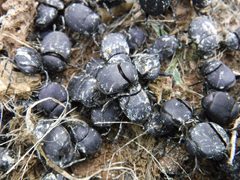
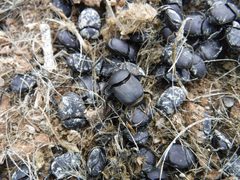
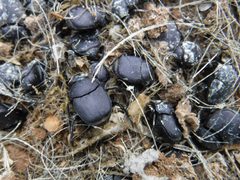
Canthon imitator is a dung beetle in the Scarabaeidae, first described by Brown in 1946. The species belongs to the Canthon, a group commonly known as tumblebugs for their of rolling into balls. Like other Canthon species, C. imitator navigates using celestial objects. The species occurs in both Nearctic and Neotropical regions, with records from the southwestern United States and multiple Mexican states.
Pronunciation
How to pronounce Canthon imitator: /ˈkænθɒn ˈɪmɪˌteɪtɔr/
These audio files are automatically generated. While they are not always 100% accurate, they are a good starting point.
Images
Distribution
Nearctic region: USA (Colorado, Kansas, Louisiana, New Mexico, Oklahoma, Texas). Neotropical region: Mexico (Durango, Hidalgo, Nuevo León, Quintana Roo, San Luis Potosí, Sonora, Tamaulipas).
Behavior
Navigates by celestial objects, an ancient predecessor to GPS. Exhibits perching typical of smaller dung beetle , sitting on leaves to await chemical signals of nearby .
Similar Taxa
- Canthon simplexBoth are small Canthon (C. simplex measure 7-8 mm) that roll balls away from source to minimize conflict with other dung beetles.
- Canthon luteicollisSimilar small roller ; C. luteicollis is a small roller (9.8 mm female) used as comparative example in perching studies.
More Details
Celestial Navigation
-rolling scarab beetles of the Canthon imitator navigate by celestial objects, representing an ancient biological predecessor to GPS technology.
Research Context
The has been studied in the context of thermal physiology and climate change research, as part of broader work on dung beetles in the tribe Canthonini across North and South America.
Sources and further reading
- BugGuide
- Wikipedia
- GBIF taxonomy match
- iNaturalist taxon
- NCBI Taxonomy
- Primary Type List | Entomology Research Museum
- You Can Thank Insects for Many Human Inventions
- Bug Eric: What's in Dat Scat?
- Teach a Man to Fish (and some entomology) and You’ll Feed Him for a Lifetime
- Where Dung Beetles Perch Says a Lot About Community Evolution
- Characterizing the Link Between Climate and Thermal Limits in Beetles