
Amphimallon majale
(Razoumowsky, 1789)
European chafer
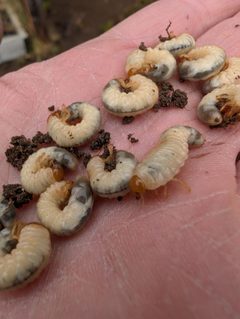
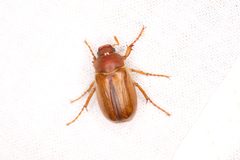
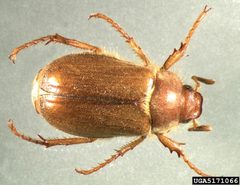
A scarab beetle native to continental Europe, now in temperate North America where it is commonly called a June bug. The large, white larvae () feed on grass roots and are significant pests of lawns and turfgrass. are short-lived and primarily reproductive. The has been introduced to Canada and the United States, where it lacks natural controls.
Pronunciation
How to pronounce Amphimallon majale: /ˌæmfɪˈmæloʊn məˈdʒeɪli/
These audio files are automatically generated. While they are not always 100% accurate, they are a good starting point.
Images
Habitat
Temperate latitudes in open grassy areas, including lawns, golf courses, pastures, and meadows. Larvae dwell in soil, feeding on root systems. are or and often found near vegetation.
Distribution
Native to continental Europe (Belgium, France, Germany, Portugal, Slovenia, Spain, Switzerland). Introduced and established in North America: Canada (British Columbia, Ontario, Quebec) and USA (California, Indiana, Maryland, Michigan, West Virginia).
Diet
Larvae feed on roots of cool-latitude grasses, both wild and cultivated .
Life Cycle
Larvae are large, white (third instars are the stage). Cold temperature treatment simulating overwintering conditions reduces disruption of downward movement in vertical soil panels.
Behavior
Larvae do not remotely detect imidacloprid in soil; they neither evade contact nor are repelled after contact. Imidacloprid acts as a contact arrestant, arresting movement at concentrations ≥0.6 ppm. At ≥0.8 ppm, this arrestant effect exceeds attraction cues from germinating grass seed. Vertical movement is less disrupted than lateral .
Human Relevance
Major pest of North American lawns and turfgrass due to root-feeding larvae. Subject of pest management research, including behavioral studies.