
Orizabus clunalis
(LeConte, 1856)
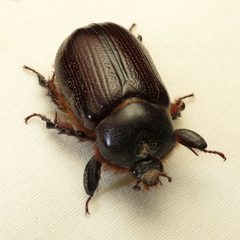
Orizabus clunalis is a rhinoceros beetle in the Dynastinae, first described by John Lawrence LeConte in 1856. It belongs to a of medium-sized scarab beetles characterized by their robust bodies and often sexually dimorphic horns in males. The is distributed across the southwestern United States and throughout much of Mexico, with records extending into Central America. It inhabits arid and semi-arid regions and is among the more frequently observed Orizabus species in its range.
Pronunciation
How to pronounce Orizabus clunalis: //ˌɔɹɪˈzeɪbəs kluˈnælɪs//
These audio files are automatically generated. While they are not always 100% accurate, they are a good starting point.
Identification
Members of the Orizabus can be distinguished from other Pentodontini by the combination of a strongly convex pronotum and the presence of a distinct, often tuberculate or horned, structure on the of males. Orizabus clunalis specifically may be separated from by details of the male genitalia and the structure of the pronotal and elytral surface sculpturing, though precise diagnostic features require examination of and literature.
Images
Habitat
Arid and semi-arid environments including desert scrub, grasslands, and open woodland areas. Associated with sandy or loamy soils suitable for larval development.
Distribution
Southwestern United States (Arizona, Colorado, New Mexico, Texas) and Mexico (Aguascalientes, Chiapas, Chihuahua, Coahuila, Distrito Federal, Durango, Guanajuato, Guerrero, Hidalgo, Jalisco, México, Michoacán, Morelos, Nuevo León, Oaxaca, Puebla, Querétaro, San Luis Potosí, Sonora, Tamaulipas, Tlaxcala, Veracruz, Zacatecas). Records also from El Salvador, Guatemala, and Honduras.
Behavior
have been observed to come to light at night. Like other dynastine scarabs, larvae likely develop in soil, feeding on decaying organic matter or roots.
Similar Taxa
- Orizabus subopacusOverlapping distribution in southwestern North America; distinguished by differences in male cephalic armature and body surface texture.
- Other Dynastinae genera (e.g., Strategus, Dynastes)Similar large scarab beetle habitus; Orizabus are generally smaller with different horn configuration and lack the extreme size of Dynastes or the posteriorly directed horns of Strategus.
More Details
Taxonomic History
Originally described as Aphonus clunalis by LeConte in 1856, later transferred to the Orizabus. The genus Orizabus currently contains approximately 20 distributed primarily in North and Central America.
Conservation Status
No formal conservation assessment has been conducted for this .