
Protaetia fusca
(Herbst, 1790)
Mango Flower Beetle, Mottled Flower Scarab
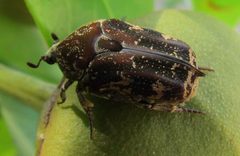
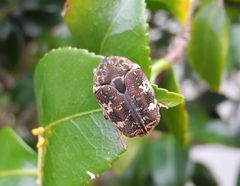
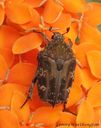
Protaetia fusca is a flower chafer in the Cetoniinae, commonly known as the Mango Flower Beetle or Mottled Flower Scarab. The has a broad distribution spanning tropical and subtropical regions of Asia, the Pacific, and has been introduced to the Americas including Hawaii, California, Florida, and the Galápagos Islands. Larvae develop in decaying wood of broad-leaved trees, particularly Ficus species, while feed on tree sap and ripe fruits. The complete takes approximately one year, with adult activity peaking during summer months.
Pronunciation
How to pronounce Protaetia fusca: /proʊˈtiːʃə ˈfʌskə/
These audio files are automatically generated. While they are not always 100% accurate, they are a good starting point.
Identification
Third instar larva distinguished from other Australian cetoniines by specific morphological characters: Eupoecila australasiae has a more pronounced frontal and different spiracular structure; Diaphonia dorsalis has distinct body setation patterns and capsule proportions. identification requires examination of elytral coloration and body proportions typical of the Protaetia.
Images
Habitat
Larval : decaying wood of broad-leaved trees, particularly Ficus (fig) , characterized by abundant and high moisture content; also recorded from decaying sugarcane. habitat: associated with trees where larvae develop; attracted to light.
Distribution
Native: Oriental region (Cambodia, India: Andaman Islands, Assam, Tripura, West Bengal; Indonesia: Lombok, Sumbawa, Flores, Sumba, Savu, Timor; Malaysia: Langkawi; Philippines; Vietnam), Palaearctic region (China: Guangxi, Fujian, Guangdong, Guizhou, Hainan, Hong Kong, Hubei, Hunan, Jiangxi, Macau, Sichuan, Yunnan, Zhejiang; India: Himachal Pradesh; Taiwan; Japan: Ryukyu Islands including Okinawa and Amami), Australian region (Queensland, Papua New Guinea), Pacific islands (New Caledonia, Tahiti). Introduced: Pacific (Hawaii), Nearctic (USA: California, Florida), Galápagos Islands, Saint Barthelemy, Oceania.
Seasonality
active June through August in Japan (Ryukyu Islands); peak June-July.
Diet
Larvae feed on decaying wood of broad-leaved trees. feed on tree sap and ripe fruits.
Host Associations
- Ficus - larval development in decaying woodparticularly important
- broad-leaved trees - larval development in decaying wood
- decaying sugarcane - alternative larval substraterecorded but less common than woody
Life Cycle
Approximately one year duration. laid in decaying wood of trees. Larval development proceeds through three instars within the wood. occurs in the larval gallery within the decaying wood. emerge in June-July and are active through August.
Behavior
attracted to light. Larvae confined to decaying wood with high moisture and abundant .
Ecological Role
Decomposer of decaying wood in forest ; contributes to nutrient cycling in tropical and subtropical broad-leaved forests.
Human Relevance
"Mango Flower " suggests association with mango , though specific economic impact not documented in sources. Introduced in Hawaii, California, Florida, and Galápagos indicate potential for range expansion via human-mediated transport.
Similar Taxa
- Eupoecila australasiaeOnly other Australian cetoniine with described larvae; distinguished by frontal and spiracular structure in third instar
- Diaphonia dorsalisOnly other Australian cetoniine with described larvae; distinguished by body setation patterns and capsule proportions in third instar