
Psammodius pierottii
Pittino, 1979
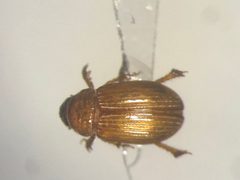
A small scarab beetle in the Aphodiinae, described from the Mediterranean region in 1979. The belongs to a of sand-dwelling beetles typically associated with sandy substrates. It has been introduced to North America, with established in Quebec, Canada.
Pronunciation
How to pronounce Psammodius pierottii: /samˈmo.di.us pjɛˈrot.ti.aɪ/
These audio files are automatically generated. While they are not always 100% accurate, they are a good starting point.
Identification
Small aphodiine scarab beetle. Distinguished from other Psammodius by subtle morphological features of the pronotum and ; accurate identification requires examination of male genitalia or comparison with type material. The is characterized by a compact body form and (digging) adaptations suited to sandy environments.
Images
Habitat
Sandy substrates, including coastal dunes, riverine sands, and other loose sandy soils. The Psammodius is strongly associated with psammophilous (sand-loving) .
Distribution
Native to the western Palaearctic region, including Albania, Algeria, Austria, France, Germany, Greece, Hungary, Italy, Malta, Slovakia, Spain, Switzerland, Tunisia, and Turkey. Introduced to North America: established in Quebec, Canada.
Behavior
habits: burrows in sandy substrates.
Human Relevance
An introduced in North America; the Quebec represents an established non-native occurrence.
Similar Taxa
- Psammodius asperCongeneric with overlapping Palaearctic distribution; distinguished by subtle differences in elytral and body proportions, requiring detailed examination.
- Other AphodiinaeSmall size and compact body form may resemble other aphodiine scarabs; the combination of sandy preference and specific pronotal shape separates Psammodius from superficially similar .