
Stenotothorax sparsus
(LeConte, 1878)
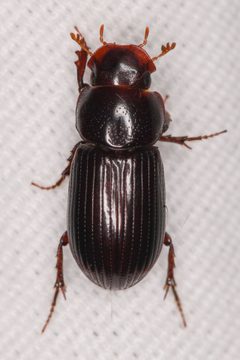
Stenotothorax sparsus is a small scarab beetle in the Aphodiinae, first described by LeConte in 1878. The is documented from limited localities in western North America, including California, Oregon, and Chihuahua, Mexico. Records remain sparse, with only seven observations documented on iNaturalist. As a member of the Aphodiinae, it likely occupies -associated , though specific ecological details remain poorly documented.
Pronunciation
How to pronounce Stenotothorax sparsus: /stɛn.o.to.ˈθo.raks ˈspar.sus/
These audio files are automatically generated. While they are not always 100% accurate, they are a good starting point.
Identification
Separation from and other small Aphodiinae requires examination of male genitalia and detailed external . The Stenotothorax is characterized by small body size, reduced wings, and distinctive pronotal and elytral . Specific diagnostic features for S. sparsus versus other Stenotothorax are not readily available in general literature.
Images
Distribution
Recorded from California and Oregon in the United States, and Chihuahua in northern Mexico. Distribution appears restricted to western North America.
Similar Taxa
- Other Stenotothorax speciesRequire genital dissection and detailed morphological comparison for reliable separation; external characters often insufficient.
- Small Aphodiinae genera (e.g., Aphodius, Ataenius)Overlap in general habitus and size; Stenotothorax distinguished by reduced wings and specific pronotal structure.
More Details
Taxonomic Note
The Stenotothorax is placed in the tribe Aphodiini, subtribe Aphodiina. The specific epithet 'sparsus' (Latin: scattered, sparse) may allude to the scattered distribution or sparse markings, though original etymology was not provided by LeConte.
Data Limitations
This is extremely poorly represented in collections and literature. Most available information derives from specimen databases rather than ecological or behavioral studies. The seven iNaturalist observations suggest genuine rarity or cryptic habits rather than simply undercollection.