
Cinacanthus militaris
(LeConte, 1858)
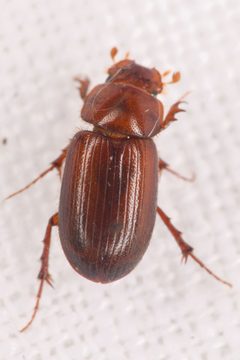
Cinacanthus militaris is a of scarab beetle in the Scarabaeidae, Aphodiinae. It occurs in western North America, with records from California, Nevada, Oregon in the United States, and Baja California in Mexico. As a member of the Aphodiinae, it is part of a group commonly known as small dung beetles or aphodiine dung beetles. The species was described by John Lawrence LeConte in 1858.


Pronunciation
How to pronounce Cinacanthus militaris: //ˌsɪ.nəˈkæn.θəs mɪˈlɪ.tɛr.ɪs//
These audio files are automatically generated. While they are not always 100% accurate, they are a good starting point.
Identification
Within the Cinacanthus, identification to level requires examination of male genitalia and detailed external . The specific epithet "militaris" may refer to markings or coloration suggestive of military insignia, though this is speculative without direct examination of type material. Separation from other Cinacanthus species depends on subtle differences in pronotal and elytral , antennal club structure, and aedeagal morphology.
Images
Habitat
Records indicate presence in arid and semi-arid regions of western North America. The Aphodiinae is broadly associated with decomposing organic matter, including and decaying plant material.
Distribution
Western North America: United States (California, Nevada, Oregon) and Mexico (Baja California).
Similar Taxa
- Other Cinacanthus speciesShare -level characters including body form and antennal structure; require dissection or detailed morphological comparison for reliable separation.
- Aphodiinae genera (e.g., Aphodius, Ataenius)Similar small body size and association with decomposing matter; differ in tarsal and antennal club structure, and male genitalia .
More Details
Taxonomic placement
The is classified in the tribe Aphodiini, subtribe Aphodiina, based on morphological characters of the mouthparts, legs, and genitalia. The classification within Scarabaeoidea has been subject to revision, with Aphodiinae sometimes treated as a Aphodiidae in older literature.
Observation frequency
As of source documentation, the has relatively few citizen science observations (13 records on iNaturalist), suggesting it may be genuinely uncommon, under-collected, or restricted to specific or seasons not frequently visited by observers.