
Aphodius fimetarius
(Linnaeus, 1758)
farmer scarab beetle
Aphodius fimetarius is a small scarab beetle native to Europe, commonly known as the farmer scarab beetle. The has been introduced to North America, where it is now widespread in cattle . Recent taxonomic work has recognized A. fimetarius as part of a with Aphodius pedellus; in Canada, only A. pedellus has been confirmed present. The serves as a for multiple , including the tachinid fly Strongygaster triangulifer and the Eudiplogaster aphodii.
Pronunciation
How to pronounce Aphodius fimetarius: /æˈfɒd.i.əs fɪ.mɪˈteə.ri.əs/
These audio files are automatically generated. While they are not always 100% accurate, they are a good starting point.
Identification
Distinguished from the closely related Aphodius pedellus by subtle morphological characters requiring detailed examination; may be necessary for definitive identification. In Canada, specimens previously identified as A. fimetarius have been reidentified as A. pedellus.
Images
Appearance
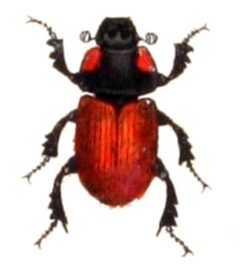
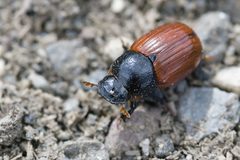
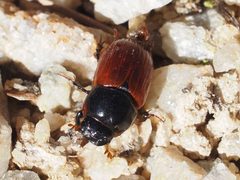
Small dung beetle with red and black coloration. Specific morphological details distinguishing it from Aphodius pedellus require expert examination.
Habitat
Cattle pats; also recorded from coyote scat containing fur from prey.
Distribution
Native to Europe; introduced to North America where it is widespread, though recent studies indicate that Canadian previously attributed to this are actually Aphodius pedellus. GBIF records indicate presence in Europe, Northern Asia (excluding China), Middle America, and North America.
Diet
Larvae feed and develop in manure; associated with .
Host Associations
- Strongygaster triangulifer - Tachinid fly; solitary primary of beetles
- Eudiplogaster aphodii - facultative with both free-living and parasitic phases
Life Cycle
Larvae live and feed in manure, then dig into soil beneath to pupate. Probably one per year.
Behavior
Tunneling activity in pats aerates the substrate.
Ecological Role
decomposition; tunneling may reduce methane emissions from cattle dung by aerating pats and limiting anaerobic conditions.
Human Relevance
May contribute to reduction of greenhouse gas emissions from cattle farming through aeration of pats.
Similar Taxa
- Aphodius pedellusFormerly considered or misidentified as A. fimetarius; now recognized as distinct within the same complex. In Canada, only A. pedellus is present.
- Canthon simplexAlso a small dung beetle, but distinguished by ball-rolling ; A. fimetarius does not roll balls.
- Trox spp.Also found on and carrion, but belong to Trogidae and have different and (feign death when disturbed, often covered in debris).
Misconceptions
The 'farmer scarab beetle' derives from a misinterpretation of the Latin 'fimetarius' (meaning 'of ') as 'farmer'; the name actually refers to the 's association with dung, not agriculture.
More Details
Taxonomic Complexity
Aphodius fimetarius sensu lato has been split into a . The 2022 Canadian study (n=2091 specimens) found only A. pedellus in Canada, suggesting previous North American records of A. fimetarius may need reevaluation.
Genome Sequencing
sequence published in 2025 (Wellcome Open Research), indicating research interest in this as a model organism.
Sources and further reading
- BugGuide
- Wikipedia
- GBIF taxonomy match
- iNaturalist taxon
- NCBI Taxonomy
- Catalogue of Life
- Bug Eric: What's in Dat Scat?
- Aphodius pedellus Archives - Entomology Today
- Dung Beetles are Saving the World from Global Warming
- Assessment of the Aphodius fimetarius–Aphodius pedellus (Coleoptera: Scarabaeidae) species complex in Canada
- Life History of Eudiplogaster Aphodii (Rhabditida: Diplogasteridae), a Facultative Parasite of Aphodius Fimetarius (Coleoptera: Scarabaeidae)
- First Scarab Host for <i>Strongygaster Triangulifer</i> (Diptera: Tachinidae): the Dung Beetle, <i>Aphodius Fimetarius</i> (Coleoptera: Scarabaeidae)
- The genome sequence of the common dung beetle, Aphodius fimetarius (Linnaeus, 1758) (Coleoptera: Scarabaeidae).