
Odontotaenius floridanus
Schuster, 1994
Archbold bess beetle, Florida Passalid
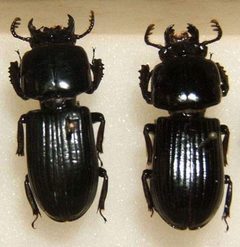
Odontotaenius floridanus is a large, black bess to the Lake Wales Ridge in Florida. measure 30–40 mm and are distinguished by golden hairs on the legs, , and pronotum, plus a single forward-pointing horn between the . The exhibits subsocial , with males carrying and showing social facilitation in group settings. Its restricted range and significant loss make it a conservation concern.


Pronunciation
How to pronounce Odontotaenius floridanus: /oʊˌdɒntoʊˈtiːniəs ˌflɒrɪˈdeɪnəs/
These audio files are automatically generated. While they are not always 100% accurate, they are a good starting point.
Identification
Distinguished from other Odontotaenius by its restriction to the Lake Wales Ridge in Florida. The combination of golden hairs on legs, , and pronotum, plus the single forward-pointing cephalic horn, separates it from sympatric passalids. The 10–15 elytral indentations and deep thoracic groove are additional diagnostic features. produce a distinctive screeching noise when disturbed, a trait shared with other bess beetles but useful for field detection.
Images
Appearance
are large, black beetles measuring 30–40 mm in length. The body is covered with golden hairs concentrated on the legs, , and pronotum. The bear 10–15 distinct indentations on the upper surface. The upper is divided vertically into two equal segments by a deep groove. The antennae consist of 10 segments, with the three segments forming a lamellated club. A single horn is positioned between the and projects forward.
Habitat
Restricted to Florida scrub and sandhill on the Lake Wales Ridge. These xeric, fire-maintained feature sandy soils, scrub oaks, and sparse ground cover. The requires decaying wood for shelter and .
Distribution
to the Lake Wales Ridge in central Florida, USA. The entire known range is confined to this ancient scrub on the Florida peninsula.
Life Cycle
lifespan has been documented at up to one year. Males carry , indicating biparental or male-focused parental care. Specific details of larval development and are not documented in available sources.
Behavior
Exhibits subsocial with social facilitation effects: males carry , and both sexes show increased speed in groups of 4–8 individuals compared to solitary conditions. Produces a screeching sound when disturbed, generated by stridulation. Engages in digging behavior, with activity enhanced in social contexts.
Ecological Role
A saproxylic associated with decaying wood in scrub . As a wood-decay , it contributes to nutrient cycling and decomposition processes in its restricted .
Human Relevance
Subject of behavioral research on social facilitation in insects. loss due to development and fire suppression has reduced its scrub and sandhill habitat to approximately 12.9% of pre-settlement extent, raising conservation concerns. No documented economic or agricultural significance.
Similar Taxa
- Odontotaenius disjunctusThe common bess overlaps in general but is distributed broadly across eastern North America rather than being to Florida; lacks the specific Lake Wales Ridge restriction and may differ in details of punctation and horn structure
More Details
Evolutionary history
The may have originated as a distinct during periods of elevated sea levels that isolated the Lake Wales Ridge from mainland Florida populations. This geographic isolation hypothesis remains under investigation.
Conservation status
The Florida scrub and sandhill has been reduced to approximately 12.9% of its pre-settlement area. status and specific threats to O. floridanus occurrences are poorly documented.