
Platyceroides keeni
(Casey, 1895)
Keen's Stag Beetle
Platyceroides keeni is a of in the Lucanidae, found in western North America from British Columbia to California. It is one of the smaller members of its and is associated with forested . beetles are active during warmer months, with larvae developing in decaying wood.
Pronunciation
How to pronounce Platyceroides keeni: //ˌplætɪˈsirɔɪdiːz ˈkiːnaɪ//
These audio files are automatically generated. While they are not always 100% accurate, they are a good starting point.
Identification
Distinguished from other Platyceroides by geographic range and subtle morphological features of the and genitalia. Smaller than most other western North American Lucanidae. The relatively modest mandible development in males separates it from larger stag beetles in related such as Platycerus. Examination of male genitalia may be required for definitive identification from .
Images
Appearance
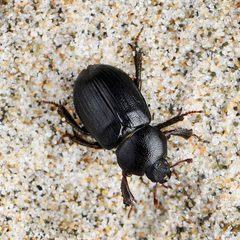
A small to medium-sized with reduced compared to larger Lucanidae. Body coloration is generally dark brown to black. Males have noticeably enlarged but relatively short mandibles; females have smaller, more typical mandibles. are elbowed with clubs. Overall body form is compact and somewhat flattened.
Habitat
Found in coniferous and mixed forests, particularly in areas with decaying wood. Associated with mature forest stands where dead and rotting logs provide larval development sites. Elevation range extends from lowland to montane forests.
Distribution
Western North America: British Columbia, Canada south through Washington and Oregon to California, USA. Distribution appears continuous through the coastal and Cascade mountain ranges.
Seasonality
have been observed from late spring through early autumn, with peak activity in summer months. Larval stages persist year-round within decaying wood substrate.
Diet
Larvae feed on decaying wood, particularly coniferous logs in advanced stages of decomposition. feeding habits are not well documented; adults of related have been observed feeding on sap, nectar, or fruit, but specific records for this species are lacking.
Life Cycle
Complete with prolonged larval development. Larvae tunnel through decaying wood, creating galleries as they feed. occurs within the wood substrate. time likely spans multiple years, as is typical for Lucanidae, though specific duration is unconfirmed for this .
Behavior
are primarily and may be attracted to light. Larvae are sedentary, remaining within their wood galleries. Adults are not known to be strong fliers.
Ecological Role
Larvae contribute to wood decomposition and nutrient cycling in forest . As saproxylic organisms, they help break down dead woody material. Their galleries may provide microhabitats for other .
Human Relevance
No significant economic or medical importance. Occasionally encountered by entomologists and naturalists. Not considered a pest .
Similar Taxa
- Platycerus spp.Larger body size and more dramatically developed in males; generally more eastern distribution for many
- Platyceroides agassiziOverlapping geographic range; requires examination of male genitalia or subtle for separation
- Sinodendron spp.Different antennal club structure and body shape; males have horn-like projections on and pronotum
More Details
Taxonomic note
The Platyceroides was historically treated as a subgenus of Platycerus but is now recognized as distinct based on morphological and phylogenetic evidence.