
Ceratocanthinae
Martínez, 1968
Pill Scarab Beetles
Genus Guides
2- Ceratocanthus(pill scarab beetles)
- Germarostes(pill scarab beetles)
Ceratocanthinae is a of scarabaeoid beetles within Hybosoridae, comprising approximately 366 in 43 distributed across three tribes. These small beetles (2.0–10.0 mm) are renowned for their unique ability to perform complete conglobation—rolling their body into a tight ball by curling three body trunk segments and folding their tibiae. This defensive , which evolved once in the Mesozoic, represents the only known complete conglobation in insects and is supported by specialized exoskeletal structures and thickened, mechanically reinforced .
Pronunciation
How to pronounce Ceratocanthinae: //ˌsɛrətəʊˈkænθɪniː//
These audio files are automatically generated. While they are not always 100% accurate, they are a good starting point.
Identification
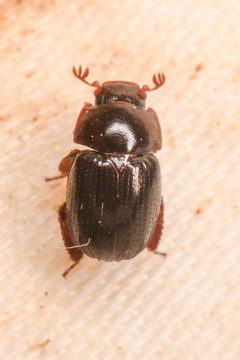
Distinguished from other scarabaeoid beetles by the presence of enrollment coaptations—specialized interlocking exoskeletal structures that enable body rolling. The combination of small size (2–10 mm), potential for complete conglobation into a sub-spherical ball, and association with dead wood, fungi, or social insect nests separates Ceratocanthinae from similar small scarabs. Within the , three conglobation archetypes exist: straight-bodied forms, incomplete conglobation, and complete conglobation. Tribal-level identification relies on morphological characters including details of the enrollment coaptations and body wall structure.
Images
Appearance
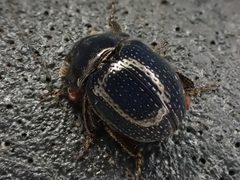
Small beetles ranging from 2.0 to 10.0 millimeters in length. Body form varies among three conglobation archetypes: straight body, incomplete conglobation, and complete conglobation. The is notably thickened with enhanced mechanical properties, particularly in capable of complete conglobation. Interlocking exoskeletal structures (enrollment coaptations) enable the tight spherical packing of body segments.
Habitat
occur on bark and branches of dead trees, on fungi, in nests, in leaf litter, and in rotten wood. Larvae inhabit spaces under bark and within burrows of bessbugs (Passalidae). The shows particular association with social insects, with adults frequently found in termite nests and colonies.
Distribution
Pantropical and subtropical distribution spanning Australian, Afrotropical, Indomalaysian, Neotropical, Nearctic, and Palaearctic regions. The likely originated in South America, with subsequent diversification into two major clades: the pantropical Ceratocanthini and the South American Scarabatermitini (including the Ivieolini).
Diet
Hypothesized to feed on fungi or debris; specific feeding habits remain poorly documented across most .
Host Associations
- Termites - associate with nestsBehavioral association; ecological nature of relationship not fully characterized
- Ants - associate with coloniesBehavioral association; ecological nature of relationship not fully characterized
- Passalidae (bessbugs) - Larval Larvae inhabit burrows of bessbugs
Life Cycle
Larval stage develops under bark and within burrows of bessbugs (Passalidae). Details of , pupal stages, and full developmental sequence not documented in available sources.
Behavior
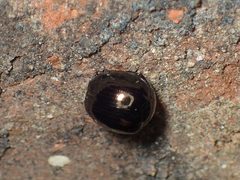
Complete conglobation is the defining behavioral trait: can roll three body trunk segments into a tight ball by curling the body and folding the tibiae, a that evolved once in the Mesozoic. This represents the only known complete conglobation in insects. Three behavioral archetypes exist: straight body (no rolling), incomplete conglobation (partial rolling), and complete conglobation (full spherical enrollment). The behavior functions as defense against attackers, with the spherical shape and reinforced providing mechanical protection. Many are flightless.
Ecological Role
Inhabits dead wood and fungal , potentially contributing to decomposition processes. Associations with , ants, and bessbugs suggest complex ecological interactions within social insect , though specific functional roles remain insufficiently studied.
Human Relevance
No documented direct economic or medical significance. Of scientific interest due to unique evolutionary origin of complete conglobation and as subjects for studies on defensive and exoskeletal biomechanics.
Similar Taxa
- Other Hybosoridae subfamiliesLack enrollment coaptations and conglobation capability; differ in body wall thickness and defensive
- Other small Scarabaeoidea (e.g., some Scarabaeidae)May share small size and dead wood but lack the specialized interlocking exoskeletal structures and complete conglobation diagnostic of Ceratocanthinae
More Details
Evolutionary history
Complete conglobation evolved once in the Mesozoic, with fossil evidence from Cretaceous and Cenozoic amber documenting the earliest incomplete and complete conglobation in beetles. The 'attackers stress' hypothesis has been proposed to explain the origin of this . Five validated adaptive characters include allometrically thickened body wall, with segment-specific adaptations representing separate evolutionary events.
Taxonomic history
Formerly treated as a separate (), now recognized as within Hybosoridae. Phylogenetic analysis supports monophyly of Ceratocanthinae with basal dichotomy between pantropical Ceratocanthini and South American Scarabatermitini (with Ivieolini rendering the latter ).
Sources and further reading
- BugGuide
- Wikipedia
- iNaturalist taxon
- NCBI Taxonomy
- Catalogue of Life
- The evolution of conglobation in Ceratocanthinae
- Biology of Ceratocanthus aeneus (Coleoptera: Scarabaeidae: Ceratocanthinae)
- Review of Madrasostes Paulian, 1975 (Coleoptera: Hybosoridae: Ceratocanthinae) from Vietnam, with remarks on its generic limits
- Notes on the Chinese fauna of Ceratocanthinae (Coleoptera: Hybosoridae), with description of a new species of Eusphaeropeltis Gestro, 1898
- Rolling into a ball: phylogeny of the Ceratocanthinae (Coleoptera: Hybosoridae) inferred from adult morphology and origin of a unique body enrollment coaptation in terrestrial arthropods