
Hybosoridae
Erichson, 1847
scavenger scarab beetles, scavenger and pill scarab beetles
Subfamily Guides
3- Ceratocanthinae(Pill Scarab Beetles)
- Hybosorinae(Scavenger Scarab Beetles)
- Pachyplectrinae
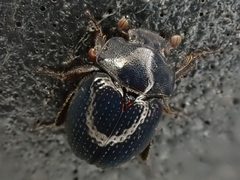
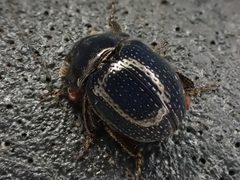
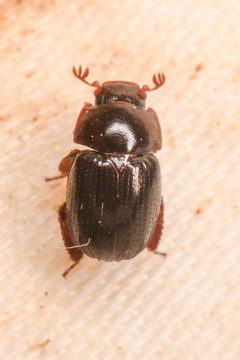
is a of scarabaeiform beetles comprising over 600 in 78 extant . Members are small (5–7 mm), oval beetles with distinctive bearing a deeply grooved 8th antennomere that houses the 9th and 10th segments. The family was historically recognized as distinct based on unique larval characteristics, particularly the stridulatory of rubbing front legs against the margin. Formerly, the family was merged into Hybosoridae, expanding its constituency.
Pronunciation
How to pronounce Hybosoridae: /haɪboʊˈsɔrɪdiː/
These audio files are automatically generated. While they are not always 100% accurate, they are a good starting point.
Identification
distinguished from similar scarabaeiform by the unique antennal club structure: the 8th antennomere is deeply grooved and houses the reduced 9th and 10th antennomeres. Large and also distinctive. Larvae uniquely identifiable by stridulatory using front legs against the margin, a habit unknown elsewhere in Scarabaeoidea. Members of the Ceratocanthinae (formerly family ) are flightless and capable of conglobation (rolling into a ball).
Images
Distribution
Widely distributed in tropical regions globally. Records from Afrotropical, Indomalayan, Neotropical, Australian, Nearctic, and Palaearctic regions. Specific documented localities include Brazil (Distrito Federal), Argentina, Vietnam (Ninh Binh Province, Ba Be National Park, Hoa Binh), Laos, Thailand, Yunnan Province (China), and Italy (Naples environs for historical Hybosorus hopei records).
Diet
feed on and vertebrate carrion; some have been found in . Larvae have been found in decomposing plant material.
Behavior
Larvae stridulate by rubbing front legs against the margin of the , a habit unique to this . Some members (Ceratocanthinae) are flightless and exhibit body enrollment coaptation (rolling into a ball).
Ecological Role
function as scavengers of carrion; larvae appear to contribute to decomposition of plant material.
Similar Taxa
- ScarabaeidaeHistorically treated as within Scarabaeidae; distinguished by unique larval stridulatory and antennal structure
- TenebrionidaeHybosorus hopei was mistakenly transferred to Tenebrionidae ( Trachyscelis) due to superficial similarities; true distinguished by scarabaeiform larval and antennal club structure
Misconceptions
The Hybosorus hopei A. , 1844 was long overlooked after being transferred to Tenebrionidae by its original author, creating confusion in Italian beetle records. The was formerly treated as distinct but is now included within as Ceratocanthinae.
More Details
Taxonomic History
Long recognized as distinct based primarily on larval characteristics, treated either as a distinct or as of Scarabaeidae. Constituency greatly expanded with inclusion of former family .
Species Diversity
Over 600 in 78 extant ; includes substantial fossil record from Cretaceous and Jurassic deposits in China, Russia, Kazakhstan, Mongolia, Germany, Dominican amber, and Lebanese amber.
Sources and further reading
- BugGuide
- Wikipedia
- GBIF taxonomy match
- iNaturalist taxon
- NCBI Taxonomy
- Catalogue of Life
- A new species of the Neotropical genus Daimothoracodes Petrovitz (Coleoptera: Scarabaeoidea: Hybosoridae)
- On the identity of Hybosorus hopei A. Costa, a forgotten Italian beetle (Coleoptera: Hybosoridae and Tenebrionidae)
- Review of Madrasostes Paulian, 1975 (Coleoptera: Hybosoridae: Ceratocanthinae) from Vietnam, with remarks on its generic limits
- Notes on the Chinese fauna of Ceratocanthinae (Coleoptera: Hybosoridae), with description of a new species of Eusphaeropeltis Gestro, 1898
- Current distribution of <i>Hybosorus illigeri </i>Reiche, 1853 (Coleoptera: Scarabaeoidea: Hybosoridae) in Russia with description of the structure of endophallus