
Laccobius agilis
(Randall, 1838)
Agile Laccobius Scavenger
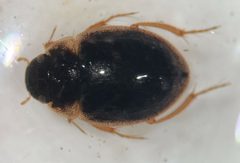
Laccobius agilis is a of water scavenger beetle in the Hydrophilidae. It is native to North America and has been recorded across a broad geographic range including much of Canada and the United States. The species is one of approximately 200 described species in the Laccobius, which are primarily associated with aquatic and semi-aquatic . Observations of this species are relatively sparse, with limited detailed ecological information available in published literature.
Pronunciation
How to pronounce Laccobius agilis: //lækˈkoʊbiəs əˈdʒɪlɪs//
These audio files are automatically generated. While they are not always 100% accurate, they are a good starting point.
Images
Habitat
Aquatic and semi-aquatic environments; typical of Hydrophilidae, in this are generally associated with freshwater including ponds, streams, and wetlands.
Distribution
North America. Documented in Canada (Alberta, British Columbia, Manitoba, New Brunswick, Newfoundland and Labrador, Nova Scotia, Ontario, Quebec) and the United States (California, Colorado, Iowa, Idaho, Illinois, Indiana, Maine, Massachusetts, Michigan, Minnesota, Montana, Nevada, New Hampshire, New Jersey, New Mexico, New York, North Carolina, North Dakota, Oregon, Pennsylvania, South Carolina, Utah, Virginia, Vermont, Washington, Wisconsin, Wyoming).
More Details
Taxonomic Note
The was originally described by Randall in 1838. The Laccobius is classified in the Hydrophilidae, a large family of aquatic beetles commonly known as water scavenger beetles.
Sources and further reading
- BugGuide
- Wikipedia
- GBIF taxonomy match
- iNaturalist taxon
- About Those Sleepovers... | Bug Squad
- The Year 2017: 'Survival of the Flittest' | Bug Squad
- 2023: These Are a Few of My Favorite Things | Bug Squad
- Seen Any Monarchs Lately? | Bug Squad
- Going Native: Do You Know the Native Bees of California? | Bug Squad
- Those Pollinator-Plant Interactions | Bug Squad
- Review of the Taiwanese Laccobius Erichson, 1837 (Coleoptera: Hydrophilidae), with description of a new species