
Novochares sallaei
(Sharp, 1882)
water scavenger beetle
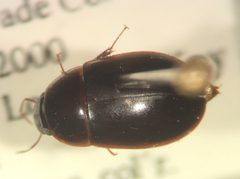
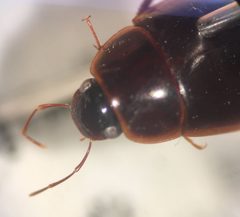
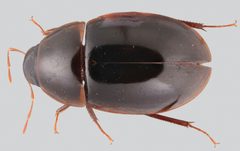
Novochares sallaei is a of water scavenger beetle in the Hydrophilidae. It is native to the United States, specifically Florida, a status clarified by a 2023 revision that corrected earlier assumptions of it being an introduced species. The species is part of the most widely distributed and commonly collected among Neotropical Acidocerinae, which spans from Mexico to Argentina including Caribbean islands.
Pronunciation
How to pronounce Novochares sallaei: //ˌnoʊvoʊˈkɛəriːz ˈsæl.aɪ.aɪ//
These audio files are automatically generated. While they are not always 100% accurate, they are a good starting point.
Identification
within Novochares exhibit relatively homogeneous external ; accurate identification to species level relies heavily on examination of male morphology due to complex and variable genital structures.
Images
Habitat
Aquatic environments. Specific microhabitat preferences for N. sallaei are not documented separately from .
Distribution
USA (Florida); Mexico; Belize; Rica. Native status in Florida confirmed; not introduced as previously suggested.
Ecological Role
Member of water scavenger beetle in aquatic . Specific ecological functions for this are not documented separately from -level patterns.
Human Relevance
Clarification of its native status in Florida has corrected a misconception regarding its biogeographic origin; no other documented human interactions.
Similar Taxa
- Other Novochares speciesExternal is relatively homogeneous across the ; male examination required for definitive separation.
Misconceptions
Previously suggested to be an introduced in Florida, USA; revisionary work has established it as native to that region.
More Details
Taxonomic revision
The was included in a comprehensive 2023 revision of Novochares that described 38 new species and clarified distributions across the .