
Helochares
Mulsant, 1844
Species Guides
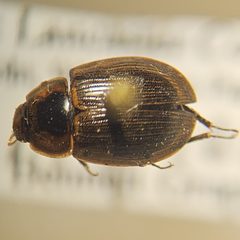
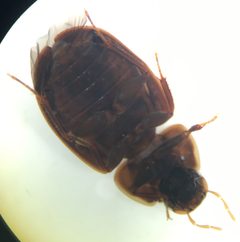
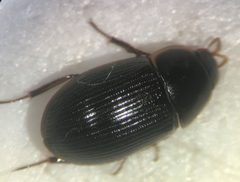
3Helochares is a large of water scavenger beetles (Hydrophilidae) comprising over 160 described distributed across multiple biogeographic realms. The genus is taxonomically problematic and has undergone substantial revision, with several former subgenera elevated to separate genera. Beetles are small to medium-sized (2–7 mm) with yellowish to brown coloration and variable elytral punctation. Females exhibit distinctive -carrying , transporting egg cocoons attached to the hind .
Pronunciation
How to pronounce Helochares: //hɛˈlɒkəˌriːz//
These audio files are automatically generated. While they are not always 100% accurate, they are a good starting point.
Identification
Identification to level requires examination of aedeagal due to high variability in this character. Elytral punctation patterns vary considerably and should not be relied upon alone. For Chinese species, a published key exists (Feng et al. 2018). European species of the lividus-group (H. lividus, H. obscurus, H. punctatus) can be distinguished by preferences and subtle morphological differences; H. punctatus was historically confused with H. obscurus but is now recognized as distinct. Consult Girón and Short (2021) for detailed generic .
Images
Appearance
Small to medium-sized beetles measuring 2–7 mm in length. Coloration ranges from yellowish to brown. Elytral punctation is highly variable in appearance between . Aedeagal shows substantial variation and is used for species-level identification. Females possess modified hind adapted for carrying cocoons.
Habitat
Aquatic and semi-aquatic environments including streams, ditches, canals, and standing waters. Western European show distinct segregation: H. lividus occupies regulated lowland streams and mineral-rich waters with luxurious vegetation; H. obscurus prefers stagnant clay and sand ditches with high conductivity; H. punctatus is restricted to acidic moorland pools, peat canals, and peat-cuttings with low pH and low conductivity. Some species tolerate low current velocities.
Distribution
Widespread across Afrotropical, Australasian, Indo-Malayan, Nearctic, and Palearctic realms. Documented from Colombia, Denmark, Norway, Cambodia, China, and throughout Western Europe including the Netherlands. In Western Europe, H. lividus occurs throughout except the northeast, with northern limit coinciding with the 8.5°C mean temperature isotherm; H. obscurus is limited to clay and peat-bog areas; H. punctatus is restricted to peat-moor or sand soils.
Seasonality
Western European show cycles with most emerging in summer. H. lividus and H. obscurus display two abundance optima annually; H. punctatus shows no clear seasonal maximum. A small proportion of hibernates as larvae or pupae, emerging in spring.
Life Cycle
documented for Western European . Females carry cocoons attached to the hind and held under the , a trait shared with other Hydrophilidae. In H. nipponicus, this has been observed to increase offspring and survivability. Development includes egg, larval, and pupal stages; some individuals overwinter as larvae or pupae rather than .
Behavior
Females exhibit cocoon-carrying , transporting eggs attached to hind . Western European show ecological segregation with limited co-existence: H. lividus regularly co-occurs with either H. obscurus or H. punctatus, but H. obscurus and H. punctatus rarely co-exist due to divergent ecological requirements.
Similar Taxa
- BatocharesFormerly treated as a subgenus of Helochares, now recognized as a separate based on phylogenetic analysis
- SindolusFormerly treated as a subgenus of Helochares, now elevated to status
- ColossocharesNewly erected containing formerly assigned to Helochares based on molecular phylogenetic data
- NovocharesNewly erected containing formerly assigned to Helochares based on molecular phylogenetic data
- Peltochares to which some former Helochares have been reassigned based on phylogenetic analysis
Misconceptions
H. punctatus was historically considered synonymous with H. obscurus but is now recognized as a distinct with different preferences and distribution.
More Details
Taxonomic History
Originally described by Étienne Mulsant in 1844. Long contained five subgenera, but recent molecular phylogenetic studies have resulted in elevation of Batochares and Sindolus to separate , synonymization of Helocharimorphus and Hydrobaticus under Helochares, and transfer of several to newly created genera (Colossochares, Novochares) or reassignments to Peltochares.
Sources and further reading
- BugGuide
- Wikipedia
- GBIF taxonomy match
- iNaturalist taxon
- NCBI Taxonomy
- Catalogue of Life
- Re visional notes on some European Helochares Muls. (Coleoptera: Hydrophilidae)
- A revision of the Chinese Helochares (s. str.) Mulsant, 1844 (Coleoptera, Hydrophilidae)
- On the habitats, distribution and life-cycles of the Western European species of the genus Helochares Mulsant (Coleoptera: Hydrophilidae)
- Egg Cocoon-Carrying Behavior in Female Water Scavenger Beetle, Helochares nipponicus (Coleoptera: Hydrophilidae), Functions to Increase Offspring Fitness and Survivability