
Trixagus
Kugelann, 1794
false click beetles
Species Guides
4- Trixagus carinicollis
- Trixagus chevrolati(false click beetle)
- Trixagus mendax(Fake Californian Throscid Beetle)
- Trixagus sericeus(Silken Throscid Beetle)
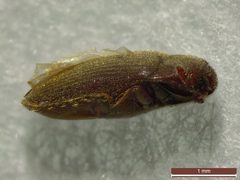
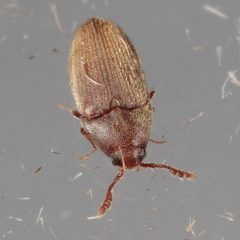
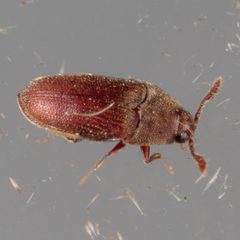
Trixagus is a of small beetles in the Throscidae, commonly known as false click beetles. The genus contains more than 30 described , with a primarily Palearctic distribution. Recent taxonomic revisions have clarified species boundaries, including the validation of T. minutus as distinct from T. obtusus. Members of this genus are distinguished from true click beetles (Elateridae) by morphological features of the prosternal process.
Pronunciation
How to pronounce Trixagus: //ˈtrɪk.sə.ɡəs//
These audio files are automatically generated. While they are not always 100% accurate, they are a good starting point.
Identification
Trixagus are small beetles, generally measuring 2–5 mm in length. They resemble click beetles (Elateridae) but lack the prosternal process that extends into the mesosternal cavity—the defining feature enabling the 'click' mechanism in Elateridae. The body form is compact and somewhat convex. Species-level identification requires examination of genitalic characters and subtle differences in antennal structure.
Images
Distribution
The has a primarily Palearctic distribution. have been documented across Europe, including Scandinavia (Denmark, Norway, Sweden), France, and Greece. Trixagus atticus, originally described from Greece, has been found in several western European countries and Cyprus.
Similar Taxa
- ElateridaeTrue click beetles share similar body shape and , but possess a functional prosternal process that creates the clicking mechanism absent in Trixagus.
- Other Throscidae generaRelated false click beetles in the same ; differentiation requires detailed examination of antennal club structure and prosternal .
More Details
Taxonomic history
Trixagus minutus Rey was long treated as a synonym of T. obtusus (Curtis) but was validated as a distinct in the atticus group through revision work. The status of T. pusillus (Heer) remains unresolved due to missing .
Species diversity
counts vary between sources: Wikipedia cites more than 30 described species, while iNaturalist reports at least 20. This discrepancy reflects ongoing taxonomic work and differing synonymy treatments.