
Erotides
Waterhouse, 1879
Species Guides
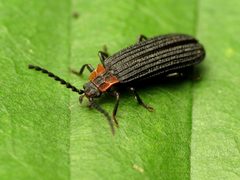
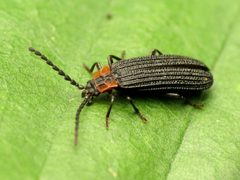
1Erotides is a of net-winged beetles ( Lycidae) established by Waterhouse in 1879. are medium-sized with elongated, flattened bodies and strongly costate, reticulate forming the characteristic net-like pattern. The genus is distributed across the Oriental and Australasian regions, including Indonesia, Malaysia, the Philippines, and Papua New Guinea. Members participate in Müllerian and complexes and are chemically defended.
Pronunciation
How to pronounce Erotides: /ˌɛroʊˈtiːdiːz/
These audio files are automatically generated. While they are not always 100% accurate, they are a good starting point.
Identification
Distinguished from other lycid by the combination of strongly costate, reticulate and serrate . Within the tribe Erotini, -level identification requires examination of regional forms and subtle morphological differences in elytral and body proportions.
Images
Habitat
are found in forested across tropical Southeast Asia and the Papuan region. Larval development is thought to occur in decaying wood, leaf litter, or soil based on patterns observed in related Lycidae.
Distribution
Oriental and Australasian regions. Documented from Indonesia (including Sumatra, Java, Borneo, Sulawesi), Malaysia, the Philippines (Luzon, Mindanao), and Papua New Guinea.
Life Cycle
Larvae are thought to develop in decaying wood, leaf litter, or soil where they feed on fungi or decomposing organic matter. Specific details on and are not documented.
Behavior
participate in Müllerian and complexes with other beetles and insects. Chemically defended and unpalatable to .
Ecological Role
Larvae contribute to decomposition processes in forest through feeding on fungi and decaying organic matter. serve as models in mimicry complexes, potentially influencing learning and structure of aposematic insects.
Similar Taxa
- Other Lycidae generaShare the characteristic net-winged elytral pattern, but Erotides is distinguished by strongly costate, reticulate and serrate within the tribe Erotini.
- Other ErotiniShare aposematic coloration and mimicry complexes; Erotides are separated by specific elytral and geographic distribution patterns.
More Details
Taxonomic history
Waterhouse's original 1879 concept was based on Indo-Australian material. Maurice Pic described additional Southeast Asian and Philippine in the 1920s, sometimes proposing separate for regional forms that were later synonymized. The genus was refined through the work of R. Kleine and catalogued by Sergei V. Kazantsev.
Species diversity
Nine are currently recognized: E. costipennis (type species), E. flavicollis, E. sumatrensis, E. javanus, E. borneensis, E. luzonicus, E. mindanaoensis, E. papuanus, and E. celebensis.