
Photuris hebes
Barber, 1951
heebie-jeebies, slow-hitch firefly
Photuris hebes is a medium-sized firefly in the Lampyridae, native to the eastern United States. measure 10–12 mm and are distinguished by their brown to nearly black with pale margins and variable pronotal coloration. Males signal with quick single flashes repeated approximately every second during summer evenings, with flash rate varying by temperature. The species is one of several in the Photuris known for of other firefly species.
Pronunciation
How to pronounce Photuris hebes: /foʊˈtjʊərɪs ˈhiːbiːz/
These audio files are automatically generated. While they are not always 100% accurate, they are a good starting point.
Identification
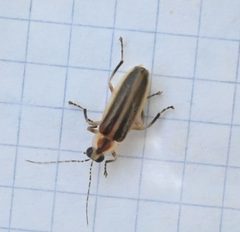
Distinguished from other Photuris by its smaller, narrower body compared to P. lucicrescens. The variable pronotal pattern—yellow with dark central mark and red or orange borders—differs from some , though regional variation complicates identification. Males can be identified by their flash pattern: quick single flashes repeated about every second, with rate increasing in warmer temperatures and slowing in cooler conditions. The species lacks the distinctive flash patterns of Photinus fireflies.
Images
Appearance
are medium-sized fireflies measuring 10–12 mm in length. The wing covers () range from brown to nearly black with light-colored side margins. Regional variation occurs in coloration: some have shoulder stripes while others lack them. The pronotum is often yellow with a dark central mark bounded by red or orange, though this also varies by region. The chest and abdominal segments are pale. Legs are longer than those of Photinus fireflies. The is smaller and narrower than Photuris lucicrescens.
Habitat
Found near trees and fencerows bordering fields, pastures, streams, and other open areas. Occupies edge where wooded areas meet open vegetation.
Distribution
Eastern United States, ranging west to Oklahoma and south to Georgia.
Seasonality
active mid-summer, from June to July.
Diet
Larvae are , feeding on snails, worms, and other soft-bodied . diet not specifically documented for this .
Life Cycle
Complete with four stages: , larva, pupa, and . The majority of the is spent as larvae, which are bioluminescent. Adults emerge in mid-summer.
Behavior
Males begin searching for mates approximately 20 minutes after sunset on summer nights. They signal with quick single flashes repeated about every second; flash frequency increases with temperature and decreases with cold. Females respond to male signals from positions in grass and possibly from trees. As a Photuris , females may engage in of other firefly , though this specific has not been directly documented for P. hebes.
Ecological Role
Larvae function as of soft-bodied in soil and leaf litter. participate in and serve as prey for various predators. The contributes to nutrient cycling through larval on decomposers and .
Human Relevance
Subject to declines from light pollution, destruction, and lawn use—factors documented for fireflies generally and likely applicable to this . Observed and appreciated for bioluminescent displays during summer evenings.
Similar Taxa
- Photuris lucicrescensLarger and broader-bodied than P. hebes; distinguished by size and proportions.
- Photinus speciesShorter legs and different flash patterns; Photuris including P. hebes have longer legs and distinct signaling .
Sources and further reading
- BugGuide
- Wikipedia
- GBIF taxonomy match
- iNaturalist taxon
- Meet Awesome Annie, the Scorpion, at UC Davis Biodiversity Museum Day | Bug Squad
- Bug Eric: Firefly Tag
- Mother Nature's Fireworks - Lightning bugs, Lampyridae — Bug of the Week
- Summer nights and Lucifer’s lights – Lightning bugs, Lampyridae — Bug of the Week
- Mother Nature’s summer light show: Lightning bugs, Lampyridae — Bug of the Week
- Just in time for the 4th of July: Firefly fireworks - Lampyridae — Bug of the Week