
Aspisoma
Laporte, 1833
Species Guides
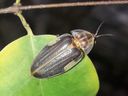
1- Aspisoma ignitum(Dixon's striped firefly)
Aspisoma is a of fireflies ( Lampyridae) comprising at least 70 described distributed primarily in the Neotropics. Species in this genus exhibit distinctive coloration patterns that differ markedly from typical North American fireflies: yellow to orange with black markings rather than the reverse, and activity in some species. The genus belongs to tribe Cratomorphini within Lampyrinae. Taxonomic knowledge of South American species remains incomplete, with many specimens identified only to genus level.
Pronunciation
How to pronounce Aspisoma: //æsˈpɪsoʊmə//
These audio files are automatically generated. While they are not always 100% accurate, they are a good starting point.
Identification
Aspisoma are distinguished from other firefly by their explanate, hood-like pronotum that covers the when viewed dorsally, and by their distinctive yellow-orange coloration with black markings (rather than black with yellow/orange markings). The activity of some species contrasts with the or habits typical of most fireflies. Species-level identification within the genus is challenging and often requires examination of male genitalia; many South American specimens remain unidentified beyond genus due to incomplete .
Images
Habitat
Agricultural fields including soybean fields; open disturbed . Specific microhabitat preferences vary by but generally associated with herbaceous vegetation in open areas.
Distribution
Neotropical distribution, with records from Argentina (Buenos Aires Province, Corrientes), Paraguay, Puerto Rico, and Colombia. The is most diverse in South America, though precise ranges of most remain poorly documented.
Seasonality
active during March in Buenos Aires Province, Argentina; activity patterns differ from typical firefly seasonality in northern regions, with some active during daylight hours.
Behavior
activity observed in some , contrasting with the or typical of most fireflies. When threatened, individuals exhibit a defensive posture: hunkering down and using the explanate pronotal flange to protect softer underparts. have been observed feeding on pollen.
Human Relevance
Occasionally encountered in agricultural settings such as soybean fields, where may be observed on vegetation. No significant documented economic impact.
Similar Taxa
- PhotinusNorth American firefly with typical black bodies and yellow/orange markings, active at night; Aspisoma differs in reversed coloration, activity, and explanate pronotum
- PhoturisAnother North American firefly ; Aspisoma lack the aggressive predatory and flash patterns characteristic of Photuris
More Details
Taxonomic challenges
The state of lampyrid in South America remains far from complete. Many specimens in collections and photographic databases are labeled only as 'Aspisoma sp.' due to lack of comprehensive revisionary work and difficulty in -level identification.
Defensive morphology
The highly explanate pronotal hood is a distinctive feature of Aspisoma that serves a clear defensive function, protecting the and body parts when the is disturbed.
Sources and further reading
- BugGuide
- GBIF taxonomy match
- iNaturalist taxon
- NCBI Taxonomy
- Catalogue of Life
- Lampyridae | Beetles In The Bush
- Argentina | Beetles In The Bush | Page 6
- Notes on the Biology of Aspisoma Ignitum (L.) (Coleoptera: Lampyridae): A New Firefly Record for Puerto Rico
- Description of the last larval instar and pupa of Aspisoma fenestrata Blanchard, 1837 (Coleoptera: Lampyridae) with brief notes on its biology
- TAXONOMY AND BEHAVIOR OF PHOTURIS TRIVITTATA SP. N. (COLEOPTERA: LAMPYRIDAE: PHOTURINAE); REDESCRIPTION OF ASPISOMA TRILINEATA (SAY) COMB. N. (COLEOPTERA\LAMPYRIDAE: LAMPYRINAE\CRATOMORPHINI)