
Perothops muscidus
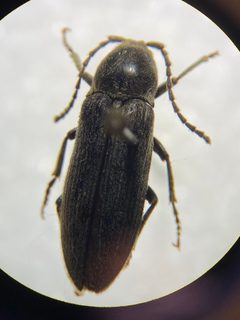
Perothops muscidus is a of false click beetle in the Eucnemidae. The Perothops is a small, distinctive group within this family, characterized by unusual morphological features. Very few observations of this species exist in public databases, reflecting either genuine rarity or cryptic habits.
Pronunciation
How to pronounce Perothops muscidus: //pɛˈroʊθɒps ˈmʌskɪdəs//
These audio files are automatically generated. While they are not always 100% accurate, they are a good starting point.
Identification
Members of Perothops can be distinguished from other Eucnemidae by their reduced or modified clicking mechanism; the prosternal process is shortened and does not engage with the mesosternal cavity in the typical false click beetle fashion. The is further characterized by elongate, somewhat flattened body form and relatively long . -level identification within Perothops requires examination of specific structural details such as pronotal and elytral .
Images
Distribution
The distribution of Perothops muscidus is poorly documented due to limited collection records. The Perothops has been recorded from western North America.
Similar Taxa
- Other Eucnemidae (false click beetles)Most eucnemids possess a functional clicking mechanism with elongated prosternal process that interlocks with mesosternal cavity; Perothops has reduced this structure, resulting in limited or no clicking ability.
- Elateridae (click beetles)True click beetles have a well-developed prosternal spine that fits into a mesosternal groove, producing the characteristic clicking/jumping ; Perothops lacks this functional mechanism despite superficial resemblance.
More Details
Taxonomic note
The Perothops is sometimes placed in the Perothopinae within Eucnemidae, reflecting its distinctive . The reduced clicking apparatus represents a derived condition within the , not a primitive absence.
Data scarcity
Only two observations of this are recorded in iNaturalist as of the knowledge cutoff, suggesting either genuine rarity, specialized requirements, or undercollection due to small size and cryptic habits.