
Perothops
Eschscholtz in Laporte, 1838
beech-tree beetles, perothopid beetles
Species Guides
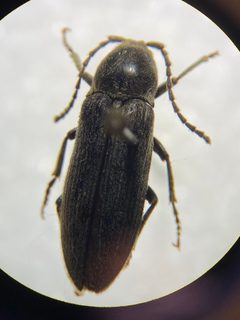
3Perothops is a of false click beetles ( Eucnemidae) and the sole genus in the Perothopinae. The genus contains three : P. witticki, P. cervinus, and P. muscidus. are small (10–18 mm), dark-colored beetles found in forests across the United States. The genus was historically treated as a separate family before being reclassified into Eucnemidae in 1993.
Pronunciation
How to pronounce Perothops: //pɛˈroʊθɒps//
These audio files are automatically generated. While they are not always 100% accurate, they are a good starting point.
Identification
distinguished from other Eucnemidae by combination of: 11-segmented not reaching middle of ; prothorax with straight sides and acute, strongly produced angles; metaventrite longer than first abdominal ventrite; and simple lacking and lobes. -level identification relies on coloration and pronotal angles: P. witticki is reddish-brown with yellowish-gray hairs and rounded sides but sharp posterior angle; P. cervinus has divergent, acute, long posterior angle; P. muscidus has shorter posterior angle and shorter lateral lobes. P. witticki and P. cervinus occur in southern California; P. muscidus is eastern U.S. species.
Images
Habitat
Forested areas, particularly associated with hardwood trees. P. witticki observed in associated with oak trees. P. muscidus found on old beech trees. General forest across distribution range.
Distribution
United States. P. muscidus: Eastern United States. P. witticki and P. cervinus: southern California.
Seasonality
active from mid-May through June. of P. witticki observed during this period.
Host Associations
- beech trees (Fagus) - found on old beech trees 'beech-tree beetles' derived from this association
- oak trees (Quercus) - site for hundreds of P. witticki observed falling from large oak tree; no feeding damage confirmed
Life Cycle
Larval stage described but duration and specific development details unknown. emerge mid-May to June.
Behavior
bore across wood grain, typical of false click beetles. P. witticki forms at specific locations, possibly yearly occurrences, associated with oak trees. No observed immediately before or after falling from trees. No mating observed during aggregation events.
Ecological Role
Wood-boring larvae likely contribute to decomposition of dead or dying hardwood trees. Specific ecological function not well documented.
Human Relevance
No documented economic importance. Occasionally encountered by entomologists and collectors due to association with beech and oak trees. No known pest status.
Similar Taxa
- other Eucnemidae (false click beetles)Perothops distinguished by 11-segmented not reaching middle of , prothorax with straight sides and acute angles, and simple structure
- Elateridae (click beetles)Perothops lacks the prosternal process that fits into mesosternal cavity enabling the 'click' mechanism characteristic of true click beetles
More Details
Taxonomic history
Originally described as a separate (Perothopidae), reclassified into Eucnemidae as Perothopinae by Jyrki Muona in 1993. Only in subfamily Perothopinae, which was first described by Jean Théodore Lacordaire in 1857.
Etymology
name from Greek: 'thops' meaning '', with prefix possibly referring to 'maimed/crippled' or 'little necklaces/bands', alluding to eye placement.
Research gaps
As of January 2024, larval diet unknown, conservation status unassessed, and no active research documented on this .