
Microrhagus subsinuatus
LeConte, 1852
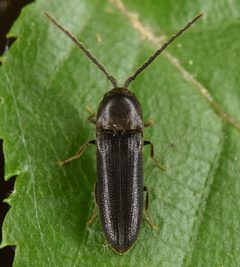
Microrhagus subsinuatus is a of false click beetle in the Eucnemidae, described by LeConte in 1852. The species is known from eastern Canada, with records from Manitoba, New Brunswick, Nova Scotia, Ontario, and Prince Edward Island. Eucnemid beetles are generally associated with decaying wood and forest . The Microrhagus contains small, slender species that can be distinguished from true click beetles (Elateridae) by their reduced clicking mechanism.
Pronunciation
How to pronounce Microrhagus subsinuatus: /maɪˌkrɔˈræɡəs ˌsʌb.sɪn.juˈeɪ.təs/
These audio files are automatically generated. While they are not always 100% accurate, they are a good starting point.
Identification
Members of Microrhagus can be separated from similar elateroid beetles by their slender, somewhat flattened body form and reduced prosternal process that does not form a functional clicking mechanism. The name "subsinuatus" refers to the slightly wavy or sinuate elytral margins. Within the , M. subsinuatus may be distinguished from by subtle differences in pronotal and elytral , though specific diagnostic features require examination of type material or detailed revisionary work.
Images
Habitat
Associated with forested environments; larvae of Eucnemidae typically develop in decaying wood, particularly in moist, rotting hardwoods.
Distribution
Eastern Canada: Manitoba, New Brunswick, Nova Scotia, Ontario, and Prince Edward Island.
Similar Taxa
- Microrhagus spp.Other in the share the general body plan and reduced clicking mechanism; species-level identification requires detailed examination of external and genitalic characters.
- Elateridae (true click beetles)True click beetles possess a functional prosternal process that produces the characteristic clicking sound; Microrhagus lacks this mechanism and has a more slender, flattened body.