
Dicrepidius
Eschscholtz, 1829
Species Guides
4- Dicrepidius corvinus
- Dicrepidius palmatus(Eastern Palmate Click Beetle)
- Dicrepidius ramicornis
- Dicrepidius serraticornis
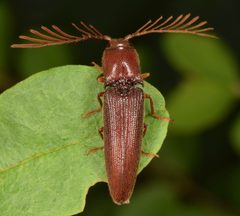
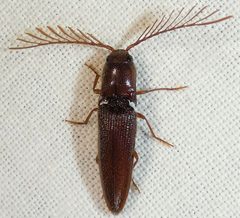
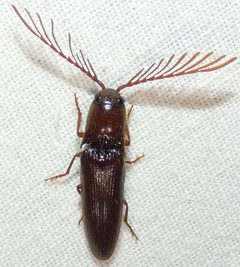
Dicrepidius is a of click beetles ( Elateridae) established by Eschscholtz in 1829. It belongs to the tribe Dicrepidiini within the Elaterinae. in this genus are characterized by their elongated body form and are distributed primarily in the Nearctic and Neotropical regions. The genus has been documented in 872 iNaturalist observations, indicating moderate public awareness and detectability.
Pronunciation
How to pronounce Dicrepidius: //dɪˈkrɛpɪdiːəs//
These audio files are automatically generated. While they are not always 100% accurate, they are a good starting point.
Identification
Dicrepidius can be distinguished from related elaterid by the combination of: prosternal process that fits into a mesosternal cavity (the 'click' mechanism); that are serrate to weakly pectinate, particularly in males; and a pronotum with well-defined lateral margins or carinae. It differs from the superficially similar genus Limonius by antennal structure and details of the prosternal . -level identification requires examination of male genitalia and detailed body proportions.
Images
Habitat
Found in forested and woodland environments, particularly in association with decaying wood and leaf litter. Larvae develop in rotting logs, stumps, and soil rich in organic matter.
Distribution
Primarily Nearctic and Neotropical, with records from North America through Central America and into South America. The shows highest diversity in tropical and subtropical regions.
Seasonality
are most commonly encountered during spring and summer months in temperate regions; activity patterns in tropical areas are less documented but likely extend throughout the year.
Life Cycle
Complete with , larva ( form), pupa, and stages. Larvae are elongate, cylindrical, and sclerotized, typical of elaterid larvae, developing in decaying woody substrates.
Behavior
exhibit the characteristic 'click' mechanism of Elateridae, using the prosternal-mesosternal junction to spring into the air when disturbed. or activity patterns have been observed.
Ecological Role
Larvae contribute to wood decomposition and nutrient cycling in forest . may serve as prey for insectivorous vertebrates and .
Human Relevance
No significant direct economic impact. Not known as agricultural pests. Occasionally encountered by entomologists and naturalists in forest .
Similar Taxa
- LimoniusSimilar elongate body form and general appearance, but differs in antennal structure (usually more strongly serrate in Limonius) and details of prosternal configuration
- AgriotesOverlapping size range and general habitus, but Agriotes typically have more convex pronota and different antennal segmentation
- AmpedusShares tribe Dicrepidiini and similar body proportions, but Ampedus often show brighter coloration and different pronotal shape
More Details
Taxonomic History
The was established by Johann Friedrich von Eschscholtz in 1829. The tribe Dicrepidiini, to which it belongs, has undergone taxonomic revision, with some authors previously treating related genera as synonyms or subgenera.
Research Needs
-level remains incompletely resolved for many Neotropical . Larval descriptions and associations are poorly documented for most species.