
Deilelater physoderus
Texas Glowing Click Beetle
Deilelater physoderus is a bioluminescent click beetle to Texas and adjacent regions. produce greenish light from paired abdominal organs, a trait shared with other members of the Agrypninae. The is among the most frequently observed glowing beetles in its range, with nearly 950 documented records. Its reflects both its geographic restriction and its distinctive display.
Pronunciation
How to pronounce Deilelater physoderus: /deɪˈlɛɪlətər ˌfaɪsəˈdɪərəs/
These audio files are automatically generated. While they are not always 100% accurate, they are a good starting point.
Identification
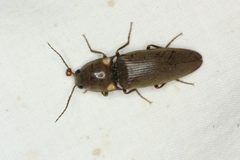
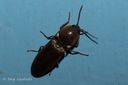
Distinguished from other North American glowing click beetles by geographic restriction to Texas and nearby areas. Larger than the eastern Pyrophorus , with proportionally smaller light organs. Light production is steady rather than flashing, emitted from two oval spots on the pronotal corners. are serrate in males, slightly less so in females. Overall body form more robust than related Deilelater species.
Images
Habitat
Found in wooded and semi-wooded across central and eastern Texas. Associated with oak-juniper woodlands, riparian corridors, and suburban areas with mature trees. frequently attracted to artificial lights.
Distribution
to Texas, USA, with records extending slightly into adjacent Oklahoma and Louisiana. Core range spans the Edwards Plateau through the Piney Woods and Gulf Coast prairie regions.
Seasonality
active from late spring through early autumn, with peak activity in June and July. Most observations occur between May and September.
Behavior
are and strongly attracted to light sources. When disturbed, exhibits the characteristic click beetle escape mechanism: a sudden flexion of the prosternal spine against the mesosternal groove produces an audible click and propels the into the air, often righting it if overturned. is continuous during and when at rest, likely serving as aposematic or mate-attraction signaling.
Human Relevance
Frequently encountered by residents and documented extensively on citizen science platforms. The has become a recognizable emblem of Texas entomofauna due to its distinctive appearance and reliable occurrence in suburban settings. No economic significance as pest or beneficial species.
Similar Taxa
- Pyrophorus noctilucusEastern North American glowing click beetle with similar but geographically separated; has larger light organs relative to body size and different pronotal shape.
- Deilelater atlanticusOccurs in Florida and the Caribbean; smaller body size and different light organ proportions.
- Ignelater spp.Other bioluminescent elaterids in the same , generally with different light organ placement and western or tropical distributions.