
Podabrus modestus
(Say, 1823)
soldier beetle
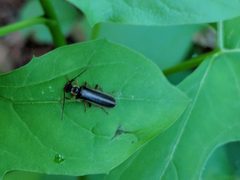
Podabrus modestus is a of soldier beetle in the Cantharidae. measure 8.5–11 mm in length. The species occurs in eastern North America, including Canada and the United States. Like other soldier beetles, it is active during the day and commonly found on flowers and foliage.
Pronunciation
How to pronounce Podabrus modestus: //pɔˈdæbɹəs moʊˈdɛstəs//
These audio files are automatically generated. While they are not always 100% accurate, they are a good starting point.
Identification
Podabrus modestus can be distinguished from similar soldier beetles by its size (8.5–11 mm), elongate body form, and characteristic coloration pattern of dark brown to black with orange, red, or yellow markings. The Podabrus is one of the common genera of soldier beetles in North America, and -level identification requires examination of specific morphological features. may be confused with other Cantharidae such as Cantharis or Chauliognathus, but Podabrus species typically have distinct antennal and pronotal proportions.
Images
Appearance
are elongate beetles measuring 8.5–11 mm in length. The body is typically dark brown to black with orange, red, or yellow markings. The is commonly bent downward. The are 11-segmented, threadlike, and usually held forward of the body. The pronotum is wider than the head and wider than long. The are smooth to velvety in appearance, soft and flexible, giving rise to the 'leatherwings' for the .
Habitat
Found in a variety of terrestrial including forests, meadows, and gardens. are commonly observed on flowers and leaves, particularly those infested with aphids or other honeydew-excreting insects. The occurs in both natural and semi-natural environments across its range.
Distribution
Eastern North America, including Canada (New Brunswick, Newfoundland, Nova Scotia) and the United States. Records indicate presence across the northeastern and north-central regions of the continent.
Behavior
are active during the day. When disturbed, adults may withdraw their legs and drop to the ground as if dead, a defensive known as . Adults, larvae, and pupae can excrete noxious, defensive chemicals from specialized abdominal glands as a defense against .
Ecological Role
are or scavengers associated with colonies and other honeydew-excreting insects. The blackish and red coloration serves as aposematic warning coloration to vertebrate predators that the beetles are distasteful due to their defensive chemical secretions.
Human Relevance
Considered beneficial in gardens and agricultural settings due to on aphids and association with pest insects. The poses no threat to humans and does not damage crops or structures.
Similar Taxa
- Cantharis spp.Similar elongate body form and coloration, but Cantharis typically differ in antennal proportions and pronotal shape.
- Chauliognathus spp.Another common of soldier beetles with similar habits, but Chauliognathus often have more extensive yellow or orange coloration and different body proportions.
- Other Podabrus speciesCongeneric require detailed examination of genitalia and other subtle morphological features for reliable identification.
More Details
Defensive Chemistry
Like other cantharid beetles, Podabrus modestus possesses specialized abdominal glands that produce noxious defensive chemicals. This chemical defense, combined with aposematic coloration, protects against vertebrate . The defensive compounds are distinct from the highly toxic found in blister beetles ( Meloidae), despite the similar 'soldier beetle' and family-level relationship.
Taxonomic History
The was described by Thomas Say in 1823, one of the earliest American entomologists. The Podabrus remains taxonomically challenging, with species boundaries sometimes difficult to establish based on external alone.
Sources and further reading
- BugGuide
- Wikipedia
- GBIF taxonomy match
- iNaturalist taxon
- NCBI Taxonomy
- Entomologists Did These! | Bug Squad
- Encyrtid Holdings | Entomology Research Museum
- Some Varieties of Annual Flowers Have a Place in Pollinator-Friendly Gardens
- Ascalaphidae | Beetles In The Bush
- August | 2022 | Beetles In The Bush
- entomology | Beetles In The Bush | Page 5