
Sternechus
Schoenherr, C.J., 1826
true weevils
Species Guides
2- Sternechus armatus
- Sternechus paludatus(Bean Stalk Weevil)
Sternechus is a of true weevils ( Curculionidae) containing more than 50 described . The genus is best known for Sternechus subsignatus, a significant agricultural pest of soybean in South America known locally as 'picudo grande' (big weevil). This species was first detected in southern Brazil in the 1970s and has since spread to northern Brazil and Argentina, where it causes economic damage through stem boring that can result in stand loss. Some species in the genus have been treated as distinct species in certain regions; for example, S. subsignatus in northern Argentina is sometimes considered S. pinguis. The genus is part of the extraordinarily diverse Curculionidae, which with approximately 60,000 species represents one of the largest families in the animal kingdom.
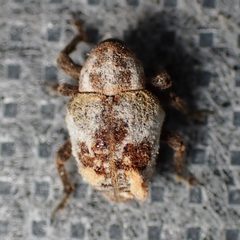
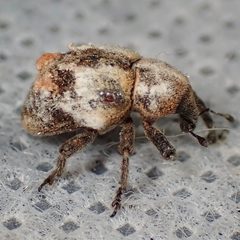
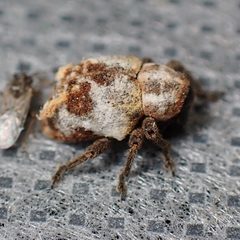
Pronunciation
How to pronounce Sternechus: /ˈstɛrnɛkʊs/
These audio files are automatically generated. While they are not always 100% accurate, they are a good starting point.
Images
Habitat
Agricultural systems, specifically soybean commercial fields under no-till systems. conceal themselves in soil or under during daylight hours to avoid sunlight.
Distribution
South America, with confirmed records from Brazil (southern and northern regions), Argentina (Salta and Tucumán Provinces), and Uruguay. The has a Neotropical distribution.
Seasonality
exhibit peak activity at dawn (6–8 a.m.) and dusk (6–8 p.m.). Mating occurs primarily at night (12 a.m.–2 a.m.), and oviposition peaks at dawn (4–6 a.m.). Adults are active during most of the day except for reduced activity between 10 a.m. and 2 p.m.
Host Associations
- Glycine max - pestsoybean
Life Cycle
are laid in ring-shaped cuts prepared by females in the epidermal tissue of plant stems, predominantly in main stems (87%) and medium plant sections. Larvae hatch and bore into stems at the oviposition site, remaining inside galls throughout their development without vertical movement. Larvae feed on stem medulla tissue, causing localized swelling with dried tissue. emerge and exhibit diel vertical patterns.
Behavior
display pronounced diel vertical : moving to the upper third of plants at night, then descending to the lower third of plants and soil during daylight hours. They exhibit negative , concealing themselves under or burying in soil to avoid sunlight. Both sexes produce and respond to , with pheromone release peaking during photophase (4–6 hours after light onset).
Ecological Role
Agricultural pest causing damage during early vegetative stages of soybean; gall formation on stems affects plant growth and can lead to stand loss. Considered the main pest of soybean in southern Brazil.
Human Relevance
Significant economic pest of soybean production in South America. Management strategies include with grass crops, for control during early vegetative stages, and foliar insecticide applications. Research is ongoing to identify and synthesize components for potential monitoring and control applications.
Similar Taxa
- Promecops carinicollisAlso a weevil pest of soybean in the same region (Tucumán Province, Argentina), but distinguished by smaller size (3–4 mm vs. larger S. subsignatus), mottled brown appearance with white elytral blotches, and feeding limited to leaf margins causing scalloped edges rather than stem boring.
- Rhyssomatus subtilisAnother weevil pest of soybean in Tucumán Province, Argentina, but distinguished by larval feeding within developing pods rather than stem boring, and feeding that clips leaf petioles.
More Details
Pheromone biology
S. subsignatus produces an with at least five male-specific compounds. Pheromone release is dependent on presence of plant food, and release peaks during photophase coincide with peak field activity.
Taxonomic note
S. subsignatus in northern Argentina (Salta and Tucumán Provinces) is sometimes treated as a distinct , S. pinguis, though this distinction requires further clarification.
Sources and further reading
- BugGuide
- Wikipedia
- GBIF taxonomy match
- iNaturalist taxon
- NCBI Taxonomy
- Catalogue of Life
- “Picudo negro” (black weevil) on soybean in Argentina | Beetles In The Bush
- economic pests | Beetles In The Bush | Page 2
- May | 2014 | Beetles In The Bush
- Curculionidae | Beetles In The Bush | Page 2
- immatures | Beetles In The Bush | Page 3
- Density and spatial distribution of different development stages of Sternechus subsignatus Boheman (Coleoptera: Curculionidae) in soybean crops
- Aggregation pheromone in Sternechus subsignatus (Coleoptera: Curculionidae): olfactory behaviour and temporal pattern of emission
- Distribution of eggs, larvae and adults of Sternechus subsignatus Boheman on soybean plants in no-till system
- Weevil Smelling Like a Moth: Bombykyl Acetate as the Aggregation-Sex Pheromone of the Brazilian Vanilla Pest, Montella sp. (Coleoptera: Curculionidae) Aggregation pheromone in Sternechus subsignatus (Coleoptera: Curculionidae): olfactory behaviour and temporal pattern of emission