
Microlarinus lareynii
(Jacquelin du Val, 1852)
Puncturevine seed weevil
Microlarinus lareynii is a seed-feeding weevil in the Curculionidae, native to the Mediterranean region and India. It was introduced to North America in the early 1960s as a agent for puncturevine (Tribulus terrestris), an weed. The exhibits strong specificity, with larvae developing exclusively within the seeds of its target host plant. Despite its potential for high reproductive output, field success in controlling weed has been variable due to climatic and biological mismatches with the host plant.

Pronunciation
How to pronounce Microlarinus lareynii: /ˌmaɪ.kroʊˌlɑːˈraɪ.nəs ləˈreɪ.ni.aɪ/
These audio files are automatically generated. While they are not always 100% accurate, they are a good starting point.
Identification
Distinguished from the related stem-feeding weevil Microlarinus lypriformis by its seed-feeding ; may be found on puncturevine plants but positive identification requires examination of larval feeding damage within seeds or expert taxonomic verification. The two Microlarinus are often used together in programs, with M. lareynii targeting seeds while M. lypriformis targets stems.
Images
Appearance
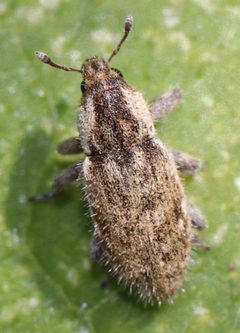
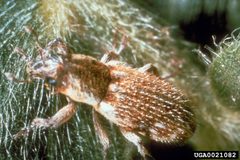
Small weevil with characteristic elongated snout typical of Curculionidae. Specific morphological details not well-documented in available sources.
Habitat
Open, sunny, disturbed areas where puncturevine (Tribulus terrestris) occurs, including roadsides, waste places, and agricultural fields. Associated with plant presence rather than specific abiotic conditions.
Distribution
Native to interior regions of Italy, France, and Rajasthan, India. Introduced to the United States (California, Arizona, and other states) and Canada for purposes. Established present in Hawaii and the conterminous 48 United States.
Seasonality
Multiple per year in favorable climates; overwinter in protected locations and become active when puncturevine seeds are developing.
Diet
feed on foliage and stems of Tribulus terrestris; larvae feed exclusively on developing seeds of this plant. Reproductive success depends on availability of green, developing seeds.
Host Associations
- Tribulus terrestris - obligateStrong specificity; larvae develop only in seeds of this . may feed on foliage of related species but do not reproduce on them.
Life Cycle
Multiple per year; overwinters as in protected locations such as under bark or in plant litter. Larval development occurs entirely within puncturevine seeds. Oviposition into developing seeds; reproductive output tied to seed availability.
Behavior
seek out puncturevine plants for feeding and oviposition. Strong fidelity to plant; laboratory and field tests confirm larvae will not develop in seeds of non-host . Used in strategies, often in combination with M. lypriformis.
Ecological Role
herbivore and agent targeting an weed. Reduces puncturevine reproductive output through seed . Part of integrated weed management programs, though effectiveness varies with climate and plant .
Human Relevance
Intentionally introduced agent for puncturevine (Tribulus terrestris), a weed that injures livestock, reduces forage quality, and damages bicycle tires. Subject of research to improve efficacy in weed suppression.
Similar Taxa
- Microlarinus lypriformisClosely related congeneric also used for puncturevine ; distinguished by stem-feeding larval versus seed-feeding in M. lareynii. The two species are often deployed together but require different monitoring approaches.
More Details
Biological Control History
Introduced to the United States in the early 1960s alongside M. lypriformis. Despite high reproductive potential, field success has been inconsistent due to mismatches between weevil climatic requirements and local conditions where puncturevine thrives.
Host Specificity Testing
Extensive laboratory and field testing has confirmed strong specificity to Tribulus terrestris, supporting its safety as a agent with minimal non-target risk.
Sources and further reading
- BugGuide
- Wikipedia
- GBIF taxonomy match
- iNaturalist taxon
- Biology of Microlarinus lareynii (Col.: Curculionidae) on Puncturevine in Southern California
- Microlarinus lypriformis and Microlarinus lareynii (Coleoptera: Curculionidae): biology and use with IPM strategies to control puncturevine
- Notes on the Ecology and Host Specificity of Microlarinus lareynii and M. lypriformis (Coleoptera: Curculionidae) and the Biological Control of Puncture Vine, Tribulus terrestris