
Panscopus rugicollis
Buchanan, 1927
broad-nosed weevil
Panscopus rugicollis is a of broad-nosed weevil in the Curculionidae, first described by Buchanan in 1927. It belongs to the Panscopus, a group within the Brachyceridae of weevils. The species is known from limited collection records across western North America.
Pronunciation
How to pronounce Panscopus rugicollis: //pænˈskəʊpəs ˌruːdʒɪˈkɒlɪs//
These audio files are automatically generated. While they are not always 100% accurate, they are a good starting point.
Identification
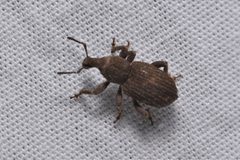
The specific epithet 'rugicollis' (from Latin ruga, wrinkle, and collis, neck/collar) suggests a wrinkled or pronotum, a feature that may distinguish it from . As a member of Panscopus, it possesses the characteristic short, broad rostrum typical of the , in contrast to the elongated snout of many other weevil groups.
Images
Distribution
Recorded from western North America, specifically from localities in California, Oregon (Adams, Baker, Blaine counties), and British Columbia, Canada.
Similar Taxa
- Other Panscopus species share the broad, short rostrum and general body form; precise identification requires examination of pronotal sculpturing and other subtle morphological characters.
- Other BrachyceridaeMembers of this can be distinguished from other Curculionidae by the short, broad rostrum, but -level identification within Panscopus requires detailed study.
More Details
Taxonomic note
Catalogue of Life lists this as 'provisionally accepted,' suggesting some taxonomic uncertainty or need for further verification. The Panscopus is currently placed in the Brachyceridae (formerly treated as a separate , now subfamily within Curculionidae).
Data scarcity
Only two observations are recorded in iNaturalist, and GBIF distribution records are limited to five localities, indicating this is a poorly documented with significant gaps in biological knowledge.