
Minyomerus
Horn, 1876
Species Guides
4- Minyomerus cracens
- Minyomerus griseus
- Minyomerus laticeps(broad-nosed weevil)
- Minyomerus microps(broad-nosed weevil)
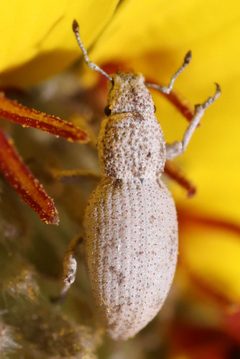
Minyomerus is a of flightless broad-nosed weevils (Curculionidae: Entiminae: Tanymecini) containing approximately 17 described . are small (2.8–6.0 mm) and characterized by reduced or absent hind wings. The genus is to western North America, inhabiting desert and semi-arid regions. Multiple species have been documented feeding on leaf tissue of creosote bush, sagebrush, and other Asteraceae.
Pronunciation
How to pronounce Minyomerus: //ˌmɪniˈoʊmərəs//
These audio files are automatically generated. While they are not always 100% accurate, they are a good starting point.
Identification
distinguished by flightlessness due to greatly reduced or absent hind wings. Body densely covered with appressed circular in earth tones, with sub-recumbent to erect setiform scales on elytral intervals. Body length ranges 2.8–6.0 mm.
Images
Habitat
Desert and plains regions; semi-arid environments including Mojave, Sonoran, Chihuahuan, and Great Basin Deserts, Great Plains, Colorado Plateau, and Baja California.
Distribution
Western North America; desert and plains regions throughout North America including Baja California, México.
Diet
Phytophagous; feeds on leaf tissue.
Host Associations
- Larrea tridentata - plantcreosote bush [Zygophyllaceae]
- Gutierrezia - plantbroomweed [Asteraceae]
- Artemisia - plantsagebrush [Asteraceae]
- Asteraceae - plantvarious members
Life Cycle
All life stages except remain unknown.
Behavior
consistently observed on leaves and branches of plants. Many appear to be host plant .