
Aphrastus griseus
(Blatchley, 1916)
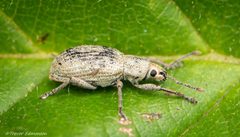
Aphrastus griseus is a of broad-nosed weevil in the Curculionidae, described by Blatchley in 1916. It belongs to the tribe Phyllobiini within the Entiminae. The species is documented from the southeastern United States, with records from Florida, Georgia, and Indiana. Like other members of its , it is likely associated with woody vegetation, though specific plant relationships remain poorly documented.
Pronunciation
How to pronounce Aphrastus griseus: /æfˈræstəs ˈɡrɪsiəs/
These audio files are automatically generated. While they are not always 100% accurate, they are a good starting point.
Identification
Aphrastus griseus can be distinguished from other Aphrastus by its grayish (griseus) coloration, as indicated by the specific epithet. Members of the Aphrastus are characterized by their broad-nosed weevil typical of Entiminae, with a short, broad rostrum and elbowed, clubbed . The species can be separated from the more widespread Aphrastus taeniatus by the absence of pale longitudinal stripes on the . Accurate identification requires examination of genitalic structures and comparison with type material.
Images
Distribution
Recorded from Florida, Georgia, and Indiana in the United States. GBIF distribution records indicate presence in North America with confirmed occurrences in Florida.
Similar Taxa
- Aphrastus taeniatusAphrastus taeniatus is the most commonly encountered in the and shares overlapping distribution in the eastern United States. It is distinguished by the presence of pale longitudinal stripes on the , which are absent in A. griseus.
- Other Phyllobiini genera (e.g., Phyllobius, Polydrusus)These European and North American broad-nosed weevils share similar general but differ in details of antennal insertion, tarsal structure, and male genitalia. Aphrastus are generally smaller and more compact than most Phyllobius.
More Details
Taxonomic history
Aphrastus griseus was described by W.S. Blatchley in 1916 based on specimens from the southeastern United States. The Aphrastus is a small North American genus within the diverse tribe Phyllobiini, which contains numerous Holarctic broad-nosed weevil . The tribal placement has been stable, though phylogenetic relationships within Phyllobiini remain incompletely resolved.
Collection records
iNaturalist reports 19 observations of this , indicating it is encountered infrequently by naturalists. Museum specimens are held in regional collections, with the species being less commonly collected than the sympatric A. taeniatus.