
Otiorhynchus carinatopunctatus
(Retzius, 1783)
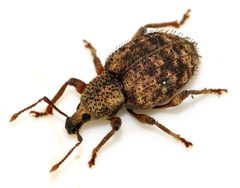
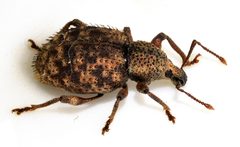
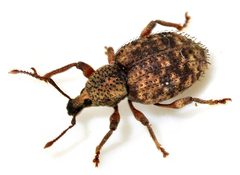
Otiorhynchus carinatopunctatus is a broad-nosed weevil in the Curculionidae. Native to Europe, it has been introduced to North America. The species was historically misidentified with Curculio scaber from 1898 until taxonomic re-examination revealed it matched specimens previously known as Trachyphloeus bifoveolatus.
Pronunciation
How to pronounce Otiorhynchus carinatopunctatus: //ˌoʊ.ti.oʊˈrɪŋ.kəs ˌkæ.rɪˌnæ.toʊˈpʌŋkˌteɪ.təs//
These audio files are automatically generated. While they are not always 100% accurate, they are a good starting point.
Identification
Distinguished from the historically confused Curculio scaber by examination. As a member of Otiorhynchus, possesses the characteristic broad rostrum typical of the . Specific diagnostic features distinguishing it from other Otiorhynchus are not documented in available sources.
Images
Distribution
Native to Europe; established in North America as an introduced . Documented occurrences include Russia (City of St. Petersburg, Kaliningrad, Mariy-El, Mordovia) and Canada (Nova Scotia).
Similar Taxa
- Curculio scaberHistorically misidentified with O. carinatopunctatus from 1898 until reinspection proved they were not identical.
- Trachyphloeus bifoveolatusO. carinatopunctatus was previously known under this name; the matched specimens identified as T. bifoveolatus upon re-examination.
Misconceptions
The was wrongly identified as Curculio scaber for over a century; this misidentification persisted from 1898 until taxonomic revision.
More Details
Taxonomic history
First described as Curculio carinatopunctatus by Retzius in 1783. Transferred to Otiorhynchus. The long-standing confusion with Curculio scaber (Linnaeus, 1758) was resolved when were reinspected and found not identical, instead matching material previously called Trachyphloeus bifoveolatus.