
Trigonoscuta
Motschulsky, 1853
broad-nosed weevils
Species Guides
5- Trigonoscuta cruzi(Cruz's broad-nosed weevil)
- Trigonoscuta miguelensis(broad-nosed weevil)
- Trigonoscuta mohawki(broad-nosed weevil)
- Trigonoscuta nicolana
- Trigonoscuta stantoni(Santa Cruz Island weevil)
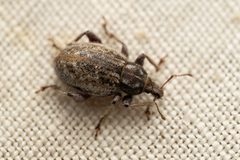
Trigonoscuta is a of broad-nosed weevils in the Curculionidae, containing at least 60 described . These beetles are characterized by their broad, short rostrum typical of the Entiminae. One species, Trigonoscuta pilosa, has been documented as prey for the weevil wasp Cerceris sextoides.
Pronunciation
How to pronounce Trigonoscuta: //ˌtrɪɡənoʊˈskjuːtə//
These audio files are automatically generated. While they are not always 100% accurate, they are a good starting point.
Identification
Members of this can be recognized as entimine weevils by their broad, short rostrum that does not extend far beyond the . The genus name 'Trigonoscuta' (meaning 'triangular shield') likely refers to characteristics of the pronotum or , though specific diagnostic features distinguishing Trigonoscuta from related genera in the tribe Geonemini require examination.
Images
Distribution
The occurs in North America. Specific range data varies by ; Trigonoscuta pilosa has been recorded in the western United States where it overlaps with the range of its Cerceris sextoides.
Ecological Role
Serves as prey for specialized hunting . Trigonoscuta pilosa is a known prey item for Cerceris sextoides, a solitary wasp that provisions its nests with paralyzed weevils for larval development.
Similar Taxa
- Other Geonemini generaSimilar broad-nosed weevil ; precise identification to level requires examination of subtle structural characters of the rostrum, , and body proportions.
- Other Entiminae generaShares the characteristic short, broad rostrum distinguishing the from other Curculionidae; differs in tribal and generic characters.
More Details
Predator documentation
The Trigonoscuta pilosa is one of only two weevil species explicitly named as prey for Cerceris sextoides in published literature, alongside Sitona californius.
Taxonomic history
Established by Motschulsky in 1853, the has grown to include at least 67 according to recent catalogues.