
Lachnopus
Schönherr, 1840
Species Guides
1Lachnopus is a of broad-nosed weevils (Curculionidae: Entiminae: Geonemini) comprising 73 described , making it the most diverse and widespread entimine weevil genus in the Caribbean Region. The genus was established by Schönherr in 1840 and has experienced unstable taxonomic placement, having been assigned to Cyphides, Barynotini, and currently Geonemini. Its validity as a distinct genus from Exophthalmus was confirmed by Franz (2012). Girón et al. (2018) recognized six species groups within the genus based on morphological phylogenetic analysis.
Identification
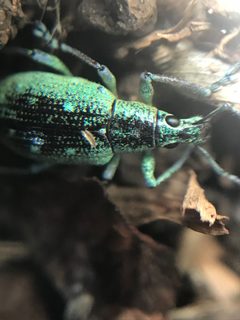
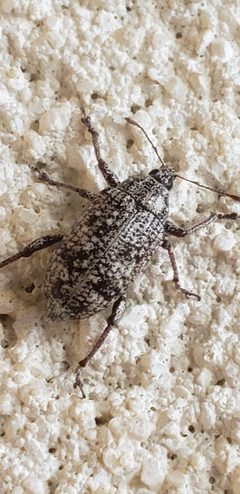
According to van Emden (1944), diagnostic characters include: rostrum weakly and evenly convex throughout; antennal scape extending to or slightly passing beyond middle of ; between eyes conspicuously narrower than surface of rostrum; not constricted posteriad of eyes; eyes only moderately convex; humeri only slightly wider than margin of pronotum; unarmed; tibiae ventrally denticulate; and metatibial corbel lacking .
Images
Habitat
Island across the Caribbean, including orchid-associated environments and agricultural settings with citrus. Specific habitat data is limited for most .
Distribution
Caribbean Region, spanning the Lucayan Archipelago (The Bahamas and Turks and Caicos Islands), Greater Antilles, Cayman Islands, and Cozumel Island (Mexico). Some occur in Florida (L. argus, L. floridanus, L. hispidus).
Host Associations
- Myrmecophila thomsoniana - Lachnopus vanessablockae collected on this Cayman banana orchid; first reported occurrence of Lachnopus weevils as
- Citrus - associatedLachnopus coffeae introduction to Grand Bahama associated with citrus transport from Puerto Rico; potential pest status
Behavior
Lachnopus vanessablockae has been observed as a of orchids, representing the first documented instance of pollination in this . Lachnopus coffeae has been introduced to new islands via human transport of citrus plants.
Ecological Role
of native orchids (documented for L. vanessablockae on Myrmecophila thomsoniana); potential agricultural pest (L. coffeae on citrus).
Human Relevance
Lachnopus coffeae has been introduced to Grand Bahama, likely via citrus transport from Puerto Rico, suggesting potential for economic impact on citrus . Some may serve as of ornamental orchids.
Similar Taxa
- ExophthalmusHistorical confusion regarding distinctness from Lachnopus; separated by Franz (2012) based on morphological characters
- IschionoplusPhylogenetic analysis places Ischionoplus as sister to the major Lachnopus clade; both belong to tribe Geonemini
More Details
Taxonomic instability
The placement of Lachnopus within Entiminae has shifted repeatedly: from Lacordaire's Cyphides (with Eustylini and Naupactini ) to Barynotini in van Emden (1944) and O'Brien and Wibmer (1982), now recognized as Geonemini.
Species groups
Girón et al. (2018) proposed six groups within Lachnopus, with three well-recognized subgroups in phylogenetic analysis: (1) widespread L. coffeae–L. lineicollis grade; (2) Hispaniolan L. proteus–L. mercator clade; (3) L. hispidus–L. guerinii clade (Cuba, Florida, Jamaica).
Phylogenetic status
Phylogenetic analysis of 61 morphological characters suggests Lachnopus may not be monophyletic as currently circumscribed, though most fall within a major L. coffeae–L. guerinii clade.
Sources and further reading
- BugGuide
- Wikipedia
- GBIF taxonomy match
- iNaturalist taxon
- NCBI Taxonomy
- Catalogue of Life
- Phylogenetic assessment of the Caribbean weevil genus Lachnopus Schoenherr (Coleoptera : Curculionidae : Entiminae)
- On the West Indian weevil genus Lachnopus Schönherr, 1840 (Coleoptera: Curculionidae: Entiminae): descriptions of six new species, a proposal for species-groups, and an annotated checklist