Clay-coloured Billbug
Sphenophorus aequalis
Classification
- Phylum: Arthropoda
- Subphylum: Hexapoda
- Class: Insecta
- Order: Coleoptera
- Suborder: Polyphaga
- Superfamily: Curculionoidea
- Family: Curculionidae
- Subfamily: Dryophthorinae
- Tribe: Rhynchophorini
- Subtribe: Sphenophorina
- Genus: Sphenophorus
- Species: aequalis
Pronunciation
How to pronounce Sphenophorus aequalis: /sfɛˈnɒfərəs iːˈkwɑːlɪs/
These audio files are automatically generated. While they are not always 100% accurate, they are a good starting point.
Images
Summary
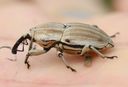
Sphenophorus aequalis, the clay-coloured billbug, is a beetle known for its impact on corn and grass species. Found predominantly in North America, it displays significant variability with several subspecies identified across its range.
Physical Characteristics
Clay-coloured beetles, typically exhibiting shades of brown or beige with a generally smooth body.
Identification Tips
Look for the characteristic long snout and distinctive coloration; can be identified by examining the genitalia of males.
Habitat
Found in a variety of habitats, typically associated with agricultural and grassy areas where they can feed on plants.
Distribution
Transcontinental distribution from northeastern British Columbia to North Carolina, Louisiana, Texas, and California; found across North America.
Diet
Primarily feeds on the stems and roots of grass and corn plants.
Life Cycle
Undergoes complete metamorphosis with a lifecycle that includes egg, larva, pupa, and adult stages.
Reproduction
Eggs are laid in the soil near host plants; larvae develop within the plant tissue, primarily feeding on the roots and stems.
Predators
Natural predators may include birds and other insects, though specific predators are not widely documented.
Ecosystem Role
Acts as a herbivore, impacting plant life; serves as a food source for predatory species.
Economic Impact
May damage corn plants, causing economic losses in agricultural settings.
Collecting Methods
- Sweep netting
- Hand collection from plants
- Trapping using baited traps
Preservation Methods
- Ethanol preservation
- Drying and mounting on pins
- Storage in insect collection boxes
Evolution
Part of the larger family Dryophthoridae, showcasing adaptations for herbivorous lifestyles including specialized mouthparts for feeding on plants.
Similar Taxa
Misconceptions
Often mistaken for other weevil species; commonly associated with agricultural destruction, which can lead to overestimation of its impact.
Tags
- beetle
- agricultural pest
- Sphenophorus aequalis