
Curculio occidentis
Casey, T.L., 1897
filbert weevil, California Acorn Weevil
Curculio occidentis, the filbert weevil, is a weevil native to western North America. It is primarily known as a seed of oak acorns, with documented on Garry oak (Quercus garryana), coast live oak (Quercus agrifolia), and other oak species. The species has also been recorded feeding on hazelnuts (Corylus avellana), though it generally prefers oak species and rarely causes economic damage to commercial hazelnut crops. Females lay small batches of 2-4 in developing acorns; larvae feed on kernels and exit in autumn to pupate in soil, potentially remaining for 1-2 years before .
Pronunciation
How to pronounce Curculio occidentis: /kʊərˈkjuːlɪ.oʊ ˌɒksɪˈdɛntɪs/
These audio files are automatically generated. While they are not always 100% accurate, they are a good starting point.
Identification
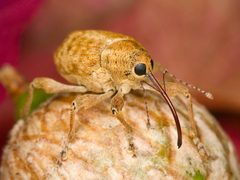
possess the characteristically elongated rostrum typical of Curculio weevils, with jaws at the tip used for drilling into acorns. Larvae are creamy white, legless that develop within acorn kernels. Specific diagnostic features distinguishing C. occidentis from other North American Curculio are not documented in available sources.
Images
Habitat
Oak woodlands and forests; specifically associated with acorn-bearing oak trees. Within-tree distribution varies with acorn crop abundance: during low crop years, occur uniformly throughout the crown; during high crop years, infestations concentrate in lower crown levels.
Distribution
Native to western North America. Range includes British Columbia (Canada), California, Arizona, New Mexico, Utah (United States), and Mexico.
Seasonality
activity coincides with oak acorn development. Larvae exit acorns in autumn when acorns fall. Adults emerge from soil chambers in spring, synchronized with oak leaf-out and new acorn production. Extended of 1-2 years in soil has been observed.
Diet
Developing kernels of acorns, primarily of oak (Quercus spp.). Documented include Garry oak (Quercus garryana) and coast live oak (Quercus agrifolia). Also feeds on hazelnuts (Corylus avellana), though with lower economic impact.
Host Associations
- Quercus garryana - primary Garry oak; up to 66% acorn recorded in British Columbia
- Quercus agrifolia - Coast live oak; higher rates in lower crown
- Corylus avellana - secondary European hazelnut; rarely causes economic damage
Life Cycle
Complete . laid in developing acorns hatch into larvae that feed on kernels. Fully developed larvae tunnel out of acorns in autumn, fall to ground, and excavate soil chambers. occurs after 1-2 years of dormancy. emerge in spring and climb to tree to feed and reproduce.
Behavior
Females drill holes in acorn husks using rostrum jaws to deposit small batches of 2-4 . Within-tree distribution patterns shift based on resource availability: uniform crown distribution during low acorn production years; preferential use of lower crown acorns during high production years.
Ecological Role
Seed of oaks. Reduces acorn germination success: heavily damaged acorns fail to germinate; lightly to moderately damaged acorns show reduced germination but unaffected seedling growth if germination occurs. rates have reached 80.7% in some Garry oak .
Human Relevance
Considered a pest of oak trees due to acorn damage. Minor relevance to hazelnut production; generally prefers oak over commercial hazelnuts. Management research limited compared to other Curculio species.
Similar Taxa
- Curculio obtususHazelnut weevil; eastern North American counterpart with similar and appearance
- Curculio nucumEuropean hazelnut weevil; similar ecological role in European hazelnut production
- Cydia latiferreanaFilbertworm moth; co-occurs on oak acorns and causes similar damage, though Lepidopteran rather than Coleopteran
- Curculio glandiumAcorn weevil; similar acorn-feeding in European and eastern North American oaks
Sources and further reading
- BugGuide
- Wikipedia
- GBIF taxonomy match
- iNaturalist taxon
- Catalogue of Life
- Saving Nutella: New Guide Details IPM for Weevil Pests in Hazelnut
- Clover Root Curculio: Historic Perspectives Guide Modern Management
- Plum Curculio: New Guide Gathers IPM Recommendations for North American Fruit Pest
- A mast year brings a bountiful harvest to acorn weevils, Curculio glandium — Bug of the Week
- Curculionidae | Beetles In The Bush | Page 3
- Curculionidae | Beetles In The Bush | Page 2
- Within-Tree Distribution of Acorns Infested by Curculio occidentis (Coleoptera: Curculionidae) and Cydia latiferreana (Lepidoptera: Tortricidae) on the Coast Live Oak
- Within-crown distribution, attack, and germination of Curculio occidentis-damaged and Cydia latiferreana-damaged Garry oak acorns in Victoria, British Columbia, Canada