
Rhopalapion longirostre
(Olivier, 1807)
Hollyhock Weevil
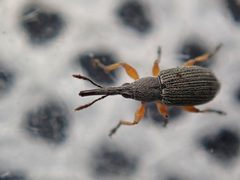
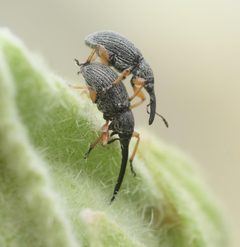
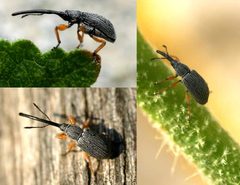
Rhopalapion longirostre is a weevil commonly known as the Hollyhock Weevil, native to central Asia and now distributed across Europe, the Middle East, and North America. It is strongly associated with hollyhock plants (Alcea species), on which it completes its entire . The species exhibits pronounced in rostrum length, with females possessing elongated rostra for oviposition. Since the 1960s, it has undergone rapid range expansion attributed to climate change and anthropogenic .
Pronunciation
How to pronounce Rhopalapion longirostre: /roʊˌfælˈæp.iˌɒn ˌlɒn.dʒɪˈrɒs.treɪ/
These audio files are automatically generated. While they are not always 100% accurate, they are a good starting point.
Identification
Distinguished from by combination of elongate body, elongate antennal club, and strong in rostrum length. Females have markedly longer rostra than males. Distinguished from Rhopalapion celatum by morphological study of ; R. celatum occurs in Turkey, Armenia, Azerbaijan, Syria, Iraq, Iran, Uzbekistan, Kyrgyzstan and Kazakhstan. Presence in hollyhock (Alcea) flowers and fruits is strongly indicative. Two distinct pupal size morphs (large: 3.00–3.50 mm; small: 1.75–2.30 mm) are notable features.
Images
Habitat
Heliophilic and xerothermophilous; occurs in pastures, meadows, roadsides, , and gardens. Found in mountain regions up to 2150 m elevation. Patchy distribution in residential areas indicates anthropogenic expansion. Strongly associated with presence of plants from Alcea.
Distribution
Native to central Asia. Since the 1960s, rapidly expanded to Middle East, Mediterranean region, across Europe (except Scandinavia) to British Isles. Introduced to North America, spreading from east to west; recorded from Canada (British Columbia, Nova Scotia, Ontario, Quebec) and United States. In France, documented from Gard (1980), Ardèche (1982), Loire, Isère, Haute-Loire, Vendée, and Hautes-Pyrénées. Also recorded from Serbia.
Seasonality
active March to November, potentially year-round in suitable conditions. Oviposition occurs May to July. First instar larvae appear 3–4 days after laying. lasts 2–6 weeks depending on weather. Whole developmental period 7–10 weeks. Multiple may coexist in single season. Adult observed in August.
Diet
Specialized seed of Alcea . Larvae consume seeds inside hollyhock pericarps, forming chambers within individual seeds. feed on plant tissues; specific adult diet details not provided in sources.
Host Associations
- Alcea digitata - larval larvae develop in seeds
- Alcea dissecta - larval larvae develop in seeds
- Alcea rosea - primary main for and development; also known as hollyhock or Rose trémière
- Alcea setosa - larval larvae develop in seeds
Life Cycle
laid in holes bored in flower buds. Larva hatches after 3–4 days, migrates to ovary, enters single pericarp, and consumes seed while forming a chamber. Larva bores escape hole and seals it with protective secretion. occurs inside pericarp lasting 2–6 weeks. Developmental period from egg to : 7–10 weeks. Multiple may coexist in single season. occurs under plant remains near plant.
Behavior
Females are efficient, active fliers. Females use elongated rostra to bore holes in flower buds for oviposition. Larvae seal escape holes in pericarps with protective secretion. Developmental includes strict association with single seeds within pericarps. Competition with Pexicopia malvella (hollyhock seed ) for development in hollyhock fruit has been observed.
Ecological Role
Specialized seed of Alcea . Competes with Pexicopia malvella caterpillars for hollyhock seed development ; this competition acts as a pathogenic factor limiting numbers. Regarded as pest of ornamental plants in some countries. Role in broader not documented in available sources.
Human Relevance
Regarded as pest of ornamental hollyhock plants in some countries. Rapid range expansion since 1960s cited as expression of response to climate change. Anthropogenic evident from patchy distribution in residential areas. Subject of extensive research with over 300 scientific papers published on various aspects of its .
Similar Taxa
- Rhopalapion celatumFormerly confused with R. longirostre; distinguished by morphological study of ; occurs in Turkey, Armenia, Azerbaijan, Syria, Iraq, Iran, Uzbekistan, Kyrgyzstan and Kazakhstan
- Pexicopia malvellaNot a but shares ; hollyhock seed caterpillars develop sympatrically in hollyhock fruit and compete for same resource, limiting R. longirostre numbers
More Details
Taxonomic History
Originally described as Apion longirostre Olivier, 1807. Lectotype designated in 2021 taxonomic revision. Rhopalapion revised in 2021, with R. celatum described as new from previously misidentified R. longirostre . placement has varied: treated as Apionidae in some sources, Brentidae in others.
Morphological Research
First comprehensive description of preimaginal stages based on 73 larvae and 67 pupae collected from 20 hollyhock plants in Poland (Lublin) and Serbia (Zemun) during 2023–2024. Descriptions revealed original features not previously observed in known immatures of Brentidae.
Sources and further reading
- BugGuide
- GBIF taxonomy match
- iNaturalist taxon
- NCBI Taxonomy
- Quelques observations sur la biologie de Rhopalapion longirostre (Olivier) (Coleoptera, Curculionidae, Apioninae)
- Immature Stages and Breeding Behaviour of the Hollyhock Weevil–Rhopalapion longirostre (Olivier 1807) (Coleoptera, Brentidae, Apioninae)
- Taxonomic revision of the genus Rhopalapion Schilsky, 1906 (Coleoptera, Apionidae) with description of Rhopalapion celatum n. sp. from the Turanian Region