
Rhopalapion
Schilsky, 1906
Species Guides
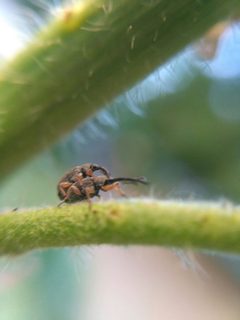
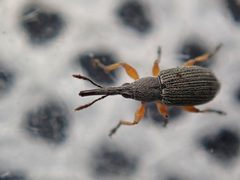
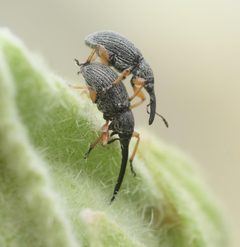
1- Rhopalapion longirostre(Hollyhock Weevil)
Rhopalapion is a of brentid weevils characterized by an elongate body, elongate antennal club, and strong in rostrum length, with females possessing a noticeably longer rostrum. The genus is strictly associated with Malvaceae plants in the genus Alcea. Two are currently recognized: the widespread and rapidly expanding R. longirostre (hollyhock weevil), and the more geographically restricted R. celatum from the Turanian Region. R. longirostre has undergone dramatic range expansion since the 1960s from central Asia across Europe to North America, attributed to climate change response and anthropogenic .
Pronunciation
How to pronounce Rhopalapion: //ˌroʊpəˈlæpiɒn//
These audio files are automatically generated. While they are not always 100% accurate, they are a good starting point.
Identification
Distinguished from related by combination of elongate body, elongate antennal club, and pronounced in rostrum length. Formerly assigned now placed in Pseudaspidapion and Harpapion based on revised . Within the genus, R. longirostre and R. celatum separated by geographic distribution and subtle morphological differences; R. celatum occurs in the Turanian Region (Turkey through Central Asia), while R. longirostre has much broader distribution.
Images
Habitat
Heliophilic and xerothermophilous; occurs in pastures, meadows, roadsides, , and gardens. Recorded at elevations up to 2150 m above sea level in mountain regions. Patchy distribution within residential areas indicates anthropogenic influence on occupancy.
Distribution
native to central Asia and adjacent regions. R. longirostre: native to central Asia; since 1960s expanded to Middle East, Mediterranean region, across Europe (except Scandinavia) to British Isles; introduced to North America with east-to-west spread. R. celatum: Turkey, Armenia, Azerbaijan, Syria, Iraq, Iran, Uzbekistan, Kyrgyzstan, Kazakhstan; type locality in Fars Province, Iran.
Seasonality
of R. longirostre active March through November, potentially year-round in favorable conditions. Oviposition occurs May through July. Whole developmental period from to adult lasts 7–10 weeks, with lasting 2–6 weeks depending on weather. Different may coexist during a single season.
Diet
Strictly associated with Malvaceae Alcea. Larvae consume seeds inside pericarps of Alcea . feed on plant tissues.
Host Associations
- Alcea digitata - larval development
- Alcea dissecta - larval development
- Alcea rosea - primary ; larval development in fruits
- Alcea setosa - larval development
Life Cycle
Females oviposit in holes bored in flower buds. First instar larva hatches after 3–4 days, migrates to ovary, enters a single pericarp, consumes seed and forms a chamber. Larva bores escape hole sealed with protective secretion. occurs inside pericarp. overwinter under plant remains close to plant.
Behavior
Efficient, active fliers, especially females. Development occurs inside Alcea pericarps with for single seeds. Sympatric development with caterpillars of Pexicopia malvella (hollyhock seed ) in hollyhock fruit creates competitive interaction.
Ecological Role
Specialized seed of Alcea . Competition with Pexicopia malvella acts as pathogenic factor limiting R. longirostre numbers. Rapid range expansion serves as documented case study of insect response to climate change.
Human Relevance
R. longirostre regarded as pest of ornamental hollyhock plants in some countries. Anthropogenic facilitated through horticultural trade of plants.
Similar Taxa
- Pseudaspidapion leptorostreFormerly assigned to Rhopalapion; distinguished by revised generic placement based on morphological characters
- Harpapion coelestipenneFormerly assigned to Rhopalapion; distinguished by revised generic placement based on morphological characters
- Pexicopia malvellaNot a weevil but hollyhock seed ; competes for same development in Alcea fruits, limiting Rhopalapion numbers
More Details
Taxonomic History
revised in 2021; name applied to Apionidae with specific combination of elongate body, elongate antennal club, and strong in rostrum length. Lectotype of Apion longirostre Olivier, 1807 designated in revision.
Range Expansion
R. longirostre documented as exceptional case of rapid range expansion in response to climate change, with over 300 scientific publications on various aspects of its despite this, stages remained undescribed until 2025.
Sources and further reading
- BugGuide
- GBIF taxonomy match
- iNaturalist taxon
- NCBI Taxonomy
- Taxonomic revision of the genus Rhopalapion Schilsky, 1906 (Coleoptera, Apionidae) with description of Rhopalapion celatum n. sp. from the Turanian Region
- Quelques observations sur la biologie de Rhopalapion longirostre (Olivier) (Coleoptera, Curculionidae, Apioninae)
- Immature Stages and Breeding Behaviour of the Hollyhock Weevil–Rhopalapion longirostre (Olivier 1807) (Coleoptera, Brentidae, Apioninae)