
Aspidapion
Schilsky, 1901
Species Guides
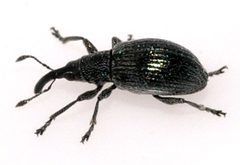
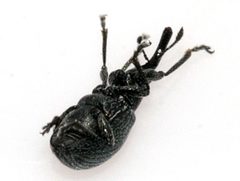
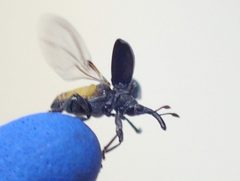
1Aspidapion is a of small weevils in the Brentidae ( Apioninae), distributed across the Palaearctic region including Europe, North Africa, and Western Asia. The genus contains approximately seven recognized , with A. aeneum being the largest British representative at 2.9–3.6 mm. Species are associated with Malvaceae plants, with larvae developing inside living plant stems. The genus is distinguished from the related Pseudaspidapion by morphological characteristics of stages.
Pronunciation
How to pronounce Aspidapion: //ˌæspɪˈdeɪpiˌɒn//
These audio files are automatically generated. While they are not always 100% accurate, they are a good starting point.
Identification
of Aspidapion aeneum, the best-documented , are distinguished by metallic bronzy or coppery contrasting with non-metallic foreparts. At 2.9–3.6 mm, it is the largest member of the in Britain. The genus is separated from the morphologically similar Pseudaspidapion by characteristics of mature larvae and pupae, including differences in body shape, chaetotaxy, and rostral structure. Specific diagnostic features for distinguishing all Aspidapion species from are not comprehensively documented in available sources.
Images
Habitat
Meadows, arable and agricultural land, and early- . In Britain, A. aeneum shows a coastal tendency towards the north and west of its range (Wales, Isle of Man).
Distribution
Palaearctic: Europe (including Great Britain, Ireland, Scandinavia, central and southern Europe), North Africa (Algeria, Morocco, Tunisia), and Western Asia (Azerbaijan, Afghanistan, Armenia, Cyprus, Georgia, Iran, Israel, Kyrgyzstan, Kazakhstan, Lebanon, Syria, Turkmenistan, Uzbekistan). In England, widespread in central and southeastern regions, more local in Wales. GBIF records indicate presence in Norway and Sweden.
Diet
Oligophagous on Malvaceae; larvae feed within stems of plants. diet is not documented.
Host Associations
- Malva sylvestris - larval
- Malva moschata - larval
- Malva pusilla - larval
- Malva neglecta - larval
- Alcea rosea - larval
- Althaea officinalis - larval
- Lavatera thuringiaca - larval
Life Cycle
Larvae develop inside living plants, feeding within stems. Despite the 'seed weevils' applied to members, larvae of at least A. aeneum do not necessarily feed in seeds. Mature larvae and pupae of A. radiolus and A. validum have been described and illustrated. Specific details on -laying, sites, and are not documented.
Behavior
High degree of -plant specificity. Develops inside living plants.
Similar Taxa
- PseudaspidapionMorphologically similar formerly confused with Aspidapion; separated based on stage including body shape, chaetotaxy, and rostral structure of larvae and pupae.
More Details
Taxonomic placement
Aspidapion has been classified in both Brentidae and Apionidae depending on taxonomic treatment; NCBI and some sources place it in Apionidae, while other classifications retain it in Brentidae Apioninae. The was established by Schilsky in 1901.
Genomic resources
A chromosomal-level assembly of 1,286.20 Mb has been published for A. aeneum, with specimen collected from coastal vegetation at Aldeburgh, Suffolk, England.
Sources and further reading
- BugGuide
- Wikipedia
- GBIF taxonomy match
- iNaturalist taxon
- NCBI Taxonomy
- Evidence from immature stages in support of separate recognition of the genera Aspidapion Schilsky, 1901 and Pseudaspidapion Wanat, 1990 (Coleoptera, Brentidae, Apioninae)
- The genome sequence of a seed weevil, Aspidapion aeneum (Fabricius, 1775).