
Stenopelmus rufinasus
Gyllenhal, 1835
Azolla Weevil, Waterfern Weevil
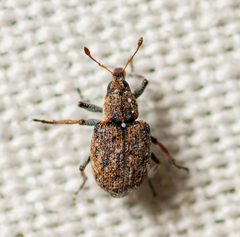
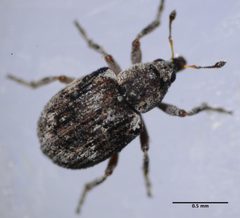
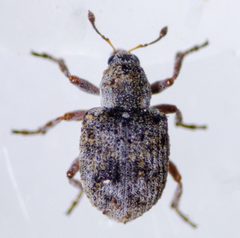
Stenopelmus rufinasus is a small weevil native to North America, introduced to Europe in 1898 alongside its plant Azolla filiculoides. The is a specialized herbivore with rapid development, completing its in approximately 20 days and producing 4-6 annually under favorable conditions. It has been widely deployed as a agent for Azolla species, particularly in South Africa where it has achieved dramatic reductions. exhibit exceptional capabilities, documented to travel up to 350 km, and frequently occur in water bodies lacking visible host plants.
Pronunciation
How to pronounce Stenopelmus rufinasus: /ˌstɛnəˈpɛlməs ˌruːfɪˈneɪsəs/
These audio files are automatically generated. While they are not always 100% accurate, they are a good starting point.
Identification
Small weevil with typical curculionid ; diagnostic characters include association with Azolla ferns in aquatic . Distinguished from native European aquatic weevils by its consistent link to Azolla filiculoides and higher frequency in disturbed wetland systems. frequently attracted to light traps, facilitating detection away from water bodies.
Images
Habitat
Aquatic and semi-aquatic environments including temporary ponds, marshes, oxbow lakes, and paddy fields. In Mediterranean systems, occurs in dune ponds with dense vegetation cover (~80%) including emergent and submerged aquatic plants. overwinter in shoreline detritus. Walks on water surface film but does not swim or crawl beneath water.
Distribution
Native to southern and western United States. Introduced to Europe (first recorded France 1898); now established across UK, Ireland, Netherlands, Belgium, Germany, Italy, Spain, Portugal, Ukraine, Hungary, Slovakia, Serbia, Poland, and Israel. In Poland, represents the most northerly central European record. Also introduced to South Africa as agent. Absent from southern Doñana National Park where water bodies are isolated.
Seasonality
detected primarily May-June in Mediterranean regions, coinciding with peak Azolla filiculoides productivity. Overwinters as adults in shoreline detritus. Multiple per year possible under favorable conditions (4-6 generations annually in California-like climates).
Diet
Specialized herbivore primarily feeding on Azolla filiculoides. Larvae feed exclusively on Azolla leaves for 4-7 days until . feed on Azolla and have been documented feeding on Salvinia minima in Louisiana and Salvinia natans in Europe. Can complete development on Azolla pinnata. Feeding on alternative aquatic plants (Agrostis stolonifera, Panicum repens, Paspalum paspalodes, Juncus heterophyllus, Isolepis pseudosetaceus, Eleocharis palustris, Ranunculus peltatus) suggested by co-occurrence but not experimentally confirmed.
Host Associations
- Azolla filiculoides - primary Typical for oviposition and larval development; essential for
- Azolla pinnata - Supports complete larval development
- Salvinia minima - food plantConfirmed feeding in Louisiana; not a reproductive
- Salvinia natans - potential European record of feeding; status unclear
Life Cycle
Rapid development: larval stage lasts 4-7 days at room temperature, complete approximately 20 days. oviposit in Azolla filiculoides fronds. Larvae feed internally or externally on leaves, pupate, and emerge as amphibious adults. Multiple per year under favorable conditions; single generation or episodic in regions with severe winters. Adults overwinter in shoreline detritus and recolonize aquatic seasonally.
Behavior
Exceptional ability: effective short-distance dispersal up to 20 km, long-distance dispersal documented to 350 km. frequently fly to light traps many kilometers from water bodies. Capable of on water surface film using surface tension. Produces extremely high densities (>30,000 adults from 2 m² of rotting fern mat reported), forcing dispersal when resources are depleted. Occurs at high densities in ponds lacking detectable host plants, suggesting use as stepping stones for range expansion.
Ecological Role
Specialized agent of Azolla filiculoides, with documented success in reducing or eradicating in South Africa. Less effective in UK due to climatic limitations. Potential for indirect effects on aquatic plant if host range expands to native ; may contribute to instability of ephemeral Azolla stands in introduced range.
Human Relevance
Widely used as agent against water fern Azolla filiculoides, particularly in South Africa where it has achieved spectacular control. Introduced in Europe are accidental hitchhikers with imported Azolla. In Poland and other northern localities, populations remain ephemeral due to plant and climatic limitations.
Similar Taxa
- Native European aquatic weevilsS. rufinasus distinguished by consistent association with Azolla filiculoides and higher frequency in disturbed wetland networks; native typically associated with diverse native aquatic vegetation
- Other Stenopelmus speciesS. rufinasus is the only member of widely introduced and established outside native range; other have restricted distributions and associations
More Details
Taxonomic note
placement varies in literature: treated as Curculionidae, Erirhinidae, or Brachyceridae depending on classification system used. GBIF and Catalogue of Life list as Brachyceridae; iNaturalist and most literature as Curculionidae; NCBI as Erirhinidae.
Control efficacy variation
Success as agent highly variable geographically: spectacular efficacy in South Africa, partial success in western Europe, limited establishment in colder climates. Climatic matching with native range predicts establishment probability.
Sources and further reading
- BugGuide
- GBIF taxonomy match
- iNaturalist taxon
- NCBI Taxonomy
- Catalogue of Life
- The Life History of Stenopelmus rufinasus (Coleoptera: Curculionidae)
- First record of Stenopelmus rufinasus Gyllenhal, 1835 (Coleoptera: Curculionidae) from Poland
- The exotic weevil Stenopelmus rufinasus Gyllenhal, 1835 (Coleoptera: Curculionidae) across a “host-free” pond network
- Life history and laboratory host range of Stenopelmus rufinasus, a natural enemy for Azolla filiculoides in South Africa
- Study on geographical distribution and population density of Stenopelmus rufinasus Gyllenhal, in paddy fields and aquatic ecosystems in northern Iran
- Native North AmericanAzollaWeevil,Stenopelmus rufinasus(Coleoptera: Curculionidae), Uses the Invasive Old WorldAzolla pinnataas a Host Plant
- Adults of the Waterfern Weevil,Stenopelmus rufinasusGyllenhal (Coleoptera: Curculionidae), Feed on a Non-Host Plant,Salvinia minimaBaker, in Louisiana