
Neochetina bruchi
Hustache, 1926
chevroned water hyacinth weevil, chevroned waterhyacinth weevil
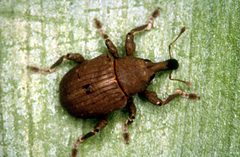
Neochetina bruchi is a South American marsh weevil introduced to over 30 countries as a agent for water hyacinth (Pontederia crassipes, formerly Eichhornia crassipes). First released in the United States in Florida in 1974, it now occurs throughout the Gulf Coast states and California. The has been studied extensively for its effectiveness in managing water hyacinth , with research showing its performance varies with environmental factors including salinity, temperature, and nutrient availability.
Pronunciation
How to pronounce Neochetina bruchi: /niːəˈkɛtɪnə ˈbruːki/
These audio files are automatically generated. While they are not always 100% accurate, they are a good starting point.
Identification
distinguished from the congeneric Neochetina eichhorniae by distinct color patterns on the (hardened forewings). Larvae and pupae are difficult to differentiate from N. eichhorniae by casual observation due to similar appearance and .
Images
Habitat
Aquatic environments supporting water hyacinth, including freshwater lakes, rivers, and canals. Research indicates reduced effectiveness in tidal brackish waters with elevated salinity.
Distribution
Native to Argentina and surrounding areas in South America. Introduced to North America: Florida (1974), Louisiana (1974), Texas (1980), and California (1982–1983). Now established throughout Gulf Coast states. Introduced to Sudan (1979) and Ethiopia, among over 30 countries worldwide. GBIF records document presence in Brazil (Amazonas, Mato Grosso, Mato Grosso do Sul, Rio Grande do Sul, Santa Catarina, São Paulo), South Africa, and the conterminous United States.
Diet
Water hyacinth (Pontederia crassipes, formerly Eichhornia crassipes). feed on leaf tissue; larvae tunnel in petioles.
Host Associations
- Pontederia crassipes - obligateformerly Eichhornia crassipes; sole for development and
Life Cycle
Complete . 5.8–7.3 days depending on season. Larval development approximately 1 month under summer conditions, extending to 140 days under winter conditions in Sudan. Pupal development approximately 59 days. Optimal oviposition temperature 25–30°C. longevity averages 57–69 days; averages 164–269 eggs per female. time varies seasonally: 94 days (summer) to 188 days (winter).
Behavior
exhibit dispersive and emigrate from plants treated with herbicides. capability present; flight muscle development affected by host plant quality.
Ecological Role
agent for water hyacinth. One of four insect introduced to the United States for water hyacinth management, alongside Neochetina eichhorniae, Niphograpta albiguttalis (), and Megamelus scutellaris (planthopper). Effectiveness reduced in high-salinity environments.
Human Relevance
Similar Taxa
- Neochetina eichhorniaeOverlapping distribution and ; both are water hyacinth biocontrol agents. distinguished by elytral color patterns; larvae and pupae nearly identical in appearance.
Sources and further reading
- BugGuide
- Wikipedia
- GBIF taxonomy match
- iNaturalist taxon
- NCBI Taxonomy
- Catalogue of Life
- Emily Bick: Salinity, the Water Hyacinth and a Weevil | Bug Squad
- High Honor for Emily Bick: ESA Student Certification Award | Bug Squad
- How Much Do You Know About Entomology? | Bug Squad
- Chevroned Water Hyacinth weevil Neochetina bruchi Hustache (Insecta: Coleoptera: Curculionidae)
- Effects of Herbicide Application on Mortality and Dispersive Behavior of the Water Hyacinth Weevils, Neochetina eichhorniae and Neochetina bruchi (Coleoptera: Curculionidae)
- Life Cycles of Neochetina bruchi Warner and Neochetina eichhorniae Hustache as Potential Biological Control Agents in the Semi Arid Zone of Nigeria
- Neochetina bruchi 1, a Biological Control Agent of Waterhyacinth: Host Specificity in Argentina2
- Optimization of Neochetina eichhorniae Warner and Neochetina bruchi Hustache for the management of water hyacinth, Eichhornia crassipes (Mart.) Solms in the Central Rift Valley lakes through the use of different nutrient levels in Ethiopia
- Effects of Host Quality on Flight Muscle Development inNeochetina eichhorniaeandN. bruchi(Coleoptera: Curculionidae)
- Biology and life tables of Neochetina bruchi Hustache (Coleoptera, Curculionidae) introduced to the White Nile, Sudan, for the biological control of water hyacinth