
Anthribus nebulosus
Forster, 1770
fungus weevil
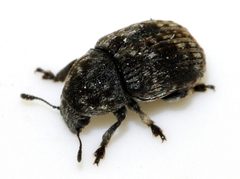
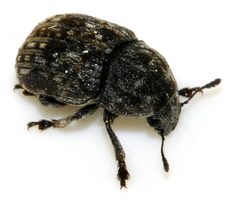
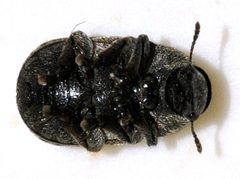
Anthribus nebulosus is a small fungus weevil in the Anthribidae. Native to Europe, the Near East, and Northern Asia (excluding China), it has been introduced to North America. overwinter in bark cracks of coniferous trees, particularly those with thicker bark such as Scots pine and larch. activity occurs primarily from early May to mid-June, peaking in late May and early June, though timing varies with weather conditions and altitude.
Pronunciation
How to pronounce Anthribus nebulosus: //ænˈθraɪbəs nɪˈbjuːləsəs//
These audio files are automatically generated. While they are not always 100% accurate, they are a good starting point.
Identification
Small weevil with pronotum width ranging 0.85–2.40 mm in males and 1.00–2.30 mm in females. Sexes are similar in size and general appearance. As a member of Anthribidae, distinguished from true weevils (Curculionidae) by straight rather than elbowed and the absence of a distinct snout. Specific diagnostic features for this require examination of genitalia or detailed morphological analysis.
Images
Habitat
Coniferous, deciduous, and mixed forests; lowland forests; forest-steppe . specifically occupy bark cracks of coniferous trees with thicker bark, primarily Pinus sylvestris and Larix decidua.
Distribution
Native to Europe, the Near East, and Northern Asia (excluding China). Introduced to North America. Within its native range, occurs across diverse forest types from lowlands to higher altitudes; at higher elevations, are active only in the first half of June.
Seasonality
active from early May to mid-June, with peak activity in late May and early June. Activity period shortened at higher altitudes. adults emerge when temperatures permit; cold and rainy spring weather delays onset of flight activity.
Host Associations
- Picea sp. - associated with for larvae or
- Pinus sp. - associated with for larvae or ; site for adults
- Abies sp. - associated with for larvae or
- Larix sp. - associated with for larvae or ; site for adults, particularly L. decidua
- Quercus sp. - associated with for larvae or
- Salix sp. - associated with for larvae or
- Fagus sp. - associated with for larvae or
Life Cycle
overwinter in bark cracks of coniferous trees. activity and presumably occur in spring (May–June). Developmental stages of larvae and pupae not documented in available sources.
Behavior
aggregate in masses in bark cracks for , making them vulnerable to . Females and males exhibit synchronous activity with equal sex ratio. Adults enter bark cracks -first; woodpeckers intensively attack trees harboring mass of overwintering adults.
Ecological Role
Prey for woodpeckers, which exploit mass . Potential of scale insects based on cited literature for the , though direct observation of not confirmed in available sources.
Human Relevance
None documented. Not known to be an agricultural or forestry pest.
Similar Taxa
- Other Anthribus speciesSimilar general appearance as fungus weevils; require genitalia examination or detailed morphological analysis for reliable separation
- True weevils (Curculionidae)Superficially similar body form but distinguished by straight (vs. elbowed in Curculionidae) and absence of a rostrum
Sources and further reading
- BugGuide
- Wikipedia
- GBIF taxonomy match
- iNaturalist taxon
- NCBI Taxonomy
- Catalogue of Life
- Bembicid Holdings | Entomology Research Museum
- Meloidae Holdings | Entomology Research Museum
- Bug Eric: Wasp Wednesday: Hoplisoides nebulosus
- Bug Eric: July 2012
- Flight activity of Anthribus nebulosus Forster, 1770 (Coleoptera: Anthribidae) and notes to its life history