
Telephanus atricapillus
Erichson, 1846
Black-headed Silvanid Beetle
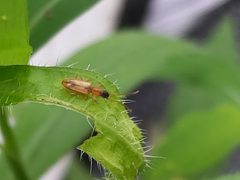
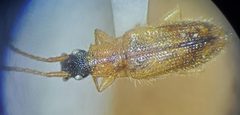
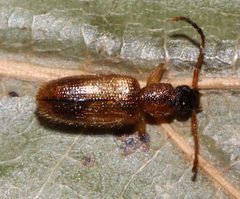
Telephanus atricapillus is a small in the Silvanidae, commonly known as the Black-headed Silvanid Beetle. It is primarily known from northeastern North America, with records from Ontario, Québec, and Vermont. The was described by Erichson in 1846 and is currently treated as a synonym of Telephanus velox in some taxonomic databases, though this synonymy may not be universally accepted. Like other silvanids, it is associated with stored products and forest floor .
Pronunciation
How to pronounce Telephanus atricapillus: /ˈtɛlɛfənəs ˌætrɪˈkæpɪləs/
These audio files are automatically generated. While they are not always 100% accurate, they are a good starting point.
Identification
Distinguished from other Telephanus by the combination of dark coloration and specific antennal club structure. Separated from similar silvanid (e.g., Silvanus, Oryzaephilus) by the form of the antennal club: Telephanus has a loose, elongate club with segments that are not compacted into a tight oval. Identification to species level within Telephanus requires examination of male genitalia and detailed comparison of punctation patterns on the pronotum and .
Images
Habitat
Associated with forest floor litter and decaying vegetation; also recorded from stored products and human-associated . In natural settings, found under bark and in rotting wood. The shows flexibility in habitat use, occurring in both undisturbed forest environments and anthropogenic settings.
Distribution
Documented from northeastern North America: Ontario and Québec in Canada, and Vermont in the United States. The distribution appears centered in the transition zone between and deciduous forests. GBIF records indicate presence in North America broadly, with specific confirmed records from the aforementioned localities.
Diet
Feeding habits poorly documented; related silvanid beetles are known to feed on fungal , decaying plant matter, and stored grain products. Specific dietary preferences for T. atricapillus have not been established.
Behavior
habits typical of the ; when disturbed, exhibits the characteristic 'play dead' () common in Silvanidae. Capable of rapid movement in confined spaces due to flattened body form.
Ecological Role
Contributes to decomposition processes in forest floor through feeding on fungal material and decaying organic matter. In stored product environments, may act as a minor pest or incidental invader without significant economic impact.
Human Relevance
Occasionally found in stored grain and food products, where it is considered a minor nuisance pest rather than a serious economic threat. Presence in stored products often indicates prior by primary pests or moisture damage. No known public health significance.
Similar Taxa
- Telephanus veloxCurrently listed as a synonym of T. atricapillus in GBIF, though treated as distinct by some sources; separation requires detailed examination of genitalia and subtle differences in punctation.
- Oryzaephilus surinamensisSimilar flattened body and stored product association; distinguished by compact, oval antennal club and lack of dark coloration.
- Silvanus bidentatusShares characteristics but has bidentate (two-toothed) pronotal angles and different antennal structure.
More Details
Taxonomic Status
The synonymy between Telephanus atricapillus and T. velox requires clarification. GBIF lists T. atricapillus as a synonym of T. velox, while other sources maintain them as distinct. The 871 iNaturalist observations suggest the name remains in active use by the naturalist regardless of formal taxonomic treatment.
Research Needs
Basic including larval development, specific dietary requirements, and precise associations remain undocumented. The would benefit from focused study to clarify its ecological role and taxonomic status relative to T. velox.